


QUOTES OF THE DAY
"Of course money can't buy happiness, but it can make you awfully comfortable while you're being miserable.” - Claire Boothe Luce
"Happiness is like a butterfly: the more you chase it, the more it will elude you, but if you turn your attention to other things, it will come and sit softly on your shoulder" - Henry David Thoreau
“Money is numbers and numbers never end. If it takes money to be happy, your search for happiness will never end.” - Bob Marley
“To succeed, jump as quickly at opportunities as you do at conclusions.” Benjamin Franklin
“Far and away the best prize that life offers is the chance to work hard at work worth doing.” - Theodore Roosevelt
SUMMARY
Let's start with a quick thought experiment:
Would you rather be a miserable billionaire or a happy middle-class person?
If you picked happiness over wealth, you are not alone – most people do when they think about this question.
Or you might be an AI. I asked ChatGPT the same question and here is what it said:
"I’d choose being a happy middle-class person, and here’s why:
Happiness is the point.
If you strip everything else away, what do we really want money for? Not the pieces of paper or the number in the account — but the experiences, freedom, and sense of meaning it can buy. If you're miserable, no amount of money fixes that. You just have more expensive distractions."
It's a pretty compelling answer. But what do you think? Do you agree with ChatGPT?
Of course, most of us care deeply about happiness — and it seems obvious that money, intelligence, or a good job is only instrumental in helping us get what we really care about, right?
Yet strangely, many of us still structure our lives around chasing money, not happiness or freedom or meaning.
We choose college majors based on salary projections, define success by income, and measure companies by stock prices instead of, say, how well they treat people.
But is that actually a smart life strategy?
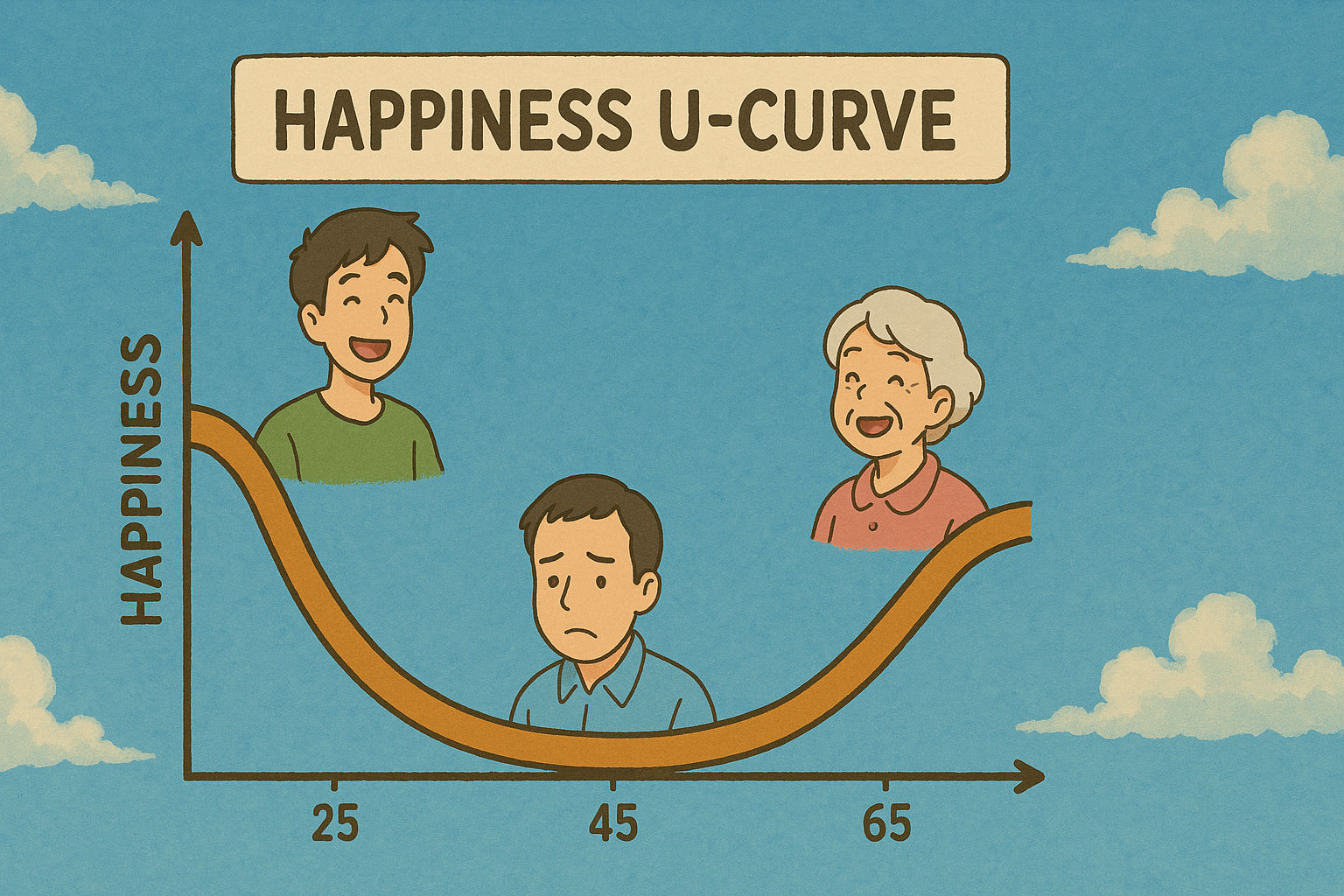
Speaking of life strategies, did you know that happiness follows a "U-curve": starting high when you are young, dipping in middle age (your mid-life crisis), and then climbing back up in older age.
Based on that traditional curve, the joke would be... enjoy your current peak, folks, because it's statistically downhill from here ... at least for the next couple of decades!
But recent data is messing up my jokes. The latest World Happiness Report suggests that for young people (ages 15-24) right here in North America, that U-bend might be broken. Youth happiness here is actually declining, falling behind older generations and even dropping the US out of the top 20 happiest countries (ouch!).
Why? The report points to factors like increasing social isolation (less support from friends/family), anxiety, stress, distrust in institutions, and major worries about things like the cost of living, finding affordable housing, political turmoil, and the climate crisis. I guess, it can only get better from here.
With the negative news out of the way, let's dive into the question you all might have:
Why Study Happiness in a Business Class?
You might be wondering: what does happiness have to do with strategic management?
Everything, as it turns out.
First, We All Care Deeply About Happiness
As our thought experiment above shows, most of us care deeply about happiness; it's the ultimate end. Even our founding fathers enshrined "the pursuit of happiness" as an unalienable right in the Declaration of Independence, alongside life and liberty. This doesn't mean you are entitled to happiness, but rather they recognized how important it is to people and acknowledged that we all have the right to pursue it (as long as we don't hurt others).
"The Constitution only guarantees the American people the right to pursue happiness. You have to catch it yourself." — Benjamin Franklin
Happiness is also increasingly becoming a global priority. Did you know that March 20th is now the International Day of Happiness. This is because in 2012, the United Nations recognized happiness as a "fundamental human goal" and encouraged countries to focus not just on measuring GDP, but also focusing on people's subjective well-being.
Bhutan famously measures Gross National Happiness instead of just GDP (although, it is not a particularly happy country). You can check the world happiness report for the latest ranking [you can check it out here]. If you want to live in the happiest country, pack some warm clothes.
The growing "happiness revolution" extends beyond governments to pop culture, where artists like Pharrell Williams top charts with songs about happiness, and best-selling books on happiness science fly off shelves (yes, happiness is a multi-billion dollar industry).
Second, Businesses Fundamentally Sell Happiness
Ask yourself, what do companies actually sell? Products and services, yes, but what they are really selling is (repackaged) happiness (or at least they want you to believe so).
Think about it: what do all these wildly successful companies really advertise? Is it just the physical product, or is it something deeper – the sort of things we humans fundamentally crave like happiness, social connection, freedom, status, or peace of mind?
Coca-Cola = Open Happiness (well, happiness)
Nike = Just Do It! (achievement)
Mastercard = Priceless (experiences)
De Beers = A Diamond is Forever (eternal love)
Red Bull = "gives you wings" (adventure)
Nutella = Spread the Happy
Disney = The Happiest Place on Earth
Smart businesses know they aren't just selling features and products; they are selling feelings, solutions to frustrations, and pathways to happiness.
As strategists, grokking what genuinely makes people happy – their joys, their anxieties, their deep-seated desires – is your best competitive edge. It’s how you create offerings that resonate and deliver the ultimate value, not just another disposable product.
Third, Happiness Drives Business Performance
Perhaps most surprisingly, the causality between success and happiness runs opposite to what most people think. As Harvard psychologist Shawn Achor demonstrates in his research on "the happiness advantage," happiness precedes success, not the other way around.
As we will discuss later in this section, when people work with a positive mindset, performance on nearly every business metric improves. Their productivity goes up, sales increase, accuracy improves, and even creativity doubles.
By the way, these aren't small effects. Research estimates that US companies lose trillions of dollars every year because their employees are not happy at work (and disengaged). This is the reason why companies like Google, Microsoft, Zappos, and Adobe invest heavily in employee happiness not just because it's nice, but because it directly impacts their bottom line.
Fourth, Understanding Happiness Will Make You a Better Leader
Beyond team performance, your personal grasp of happiness profoundly impacts your leadership effectiveness. Your emotional state literally changes how your brain works!
This is explained brilliantly by Barbara Fredrickson's "Broaden-and-Build" theory. Research shows negative emotions (like stress or fear) trigger a survival response, physically narrowing your focus – think tunnel vision, fight-or-flight. Useful if a tiger is chasing you, less so in a strategic planning meeting.
In contrast, positive emotions (like joy, interest, contentment) do the opposite: they broaden your cognitive flexibility and attention. You literally see more options, make connections you would otherwise miss, and become more creative and open to new ideas.
For leaders, this broadened mindset is gold. It leads to better, more holistic strategic decisions, fosters more effective communication, builds greater trust within teams, and crucially, enhances resilience – allowing you to navigate the inevitable business storms with a clearer head and wider perspective.
A Practical Science, Not Just Philosophy
The good news is that we don't have to philosophize about happiness—we can study it scientifically. Over the past thirty years, researchers have developed robust methods for measuring happiness and identifying its causes. We now have hard data on what actually makes people happy. In some way, the science of happiness is quite boring and confirms much of your intuition. In other ways, however, it raises many counter-intuitive questions that challenge how we approach our life and business choices.
In this section, we will explore what happiness actually is, the relationship between success and happiness, and whether money can indeed buy happiness. The insights you gain might just transform your approach to both life and business strategy.
After all, isn't creating a happier world what business should ultimately be about? Plus, who doesn't like to talk about happiness!

BUT FIRST, WHAT IS HAPPINESS?
We often talk about happiness, but we rarely stop to define it.
What is happiness?
Is it the laughter when you hang out with friends, the sense of accomplishment from finishing the semester with straight A’s, the lack of negative emotions like stress or anxiety? Is it a fleeting feeling of joy, or a deeper, more lasting sense of meaning and contentment?
HAPPINESS MACHINES
Imagine I offer you the following choice:
You can plug yourself into a "happiness machine" that will give you the feeling of having accomplished anything you desire. Want to feel like you have won a Nobel Prize? The machine can do that. Want to experience falling in love? The machine can simulate that too. Want to feel the rush of building a billion-dollar company? Just plug in.
The catch? None of it is real. You will spend the rest of your life floating in a tank, electrodes attached to your brain, experiencing a completely simulated reality. But from your perspective, it will feel 100% authentic and be filled with constant happiness.
Would you plug in?
Most people reflexively say "no" to this offer. But why? If happiness is all that matters, and the machine guarantees maximum happiness, shouldn't we all be lining up to plug in?
Our hesitation reveals something profound: We don't just want the feeling of happiness; we want authentic experiences, genuine relationships, and real accomplishments. We care about truth, not just pleasure.
This thought experiment, popularized by philosopher Robert Nozick, suggests that happiness is far more complex than just positive feelings (or what we call affective happiness). Of course, positive emotions matter, but happiness is also about meaning, authenticity, and living in accordance with our values.
HAPPINESS IS NOT ONE THING
The experiment above also shows that happiness is not a one thing. We humans care about more than just positive emotions. So when we talk about "happiness," we are actually referring to at least three distinct phenomena that don't always align:
1. Life satisfaction (or evaluative well-being). Your cognitive assessment of your life as a whole. This is what researchers measure when they ask, "All things considered, how satisfied are you with your life?"
2. Emotional well-being (or positive and negative emotions). Your day-to-day experience of positive emotions (joy, interest, excitement) and freedom from negative ones (anxiety, sadness, boredom). This is what researchers measure when they ask people to report their emotions in real-time (e.g., how do you feel right now?)
3. Eudaimonic well-being. Living a meaningful, purposeful life aligned with your values. This is what researchers measure when they ask about meaning, purpose, and personal growth.
These dimensions are related but also operate independently (they are only weakly correlated with each other). For example, a new parent might report high life meaning but low daily happiness (thanks to sleep deprivation and stress). A retiree playing golf every day might have high daily pleasure but question their life's purpose. A social activist might endure daily hardship while feeling deeply fulfilled by their impact.
Research by psychologist Ed Diener and others shows these different happiness types correlate with different factors. For instance, income correlates more strongly with life satisfaction than with daily emotions, while social connections tend to affect strongly your emotional well-being.
Which type of happiness is more important to you? What do you want and strive for in your life?
THE EXPERIENCING SELF VS. THE REMEMBERING SELF
Nobel laureate Daniel Kahneman introduces another crucial distinction: We have two selves that evaluate happiness differently [you can watch his TED talk here].
The experiencing self lives in the moment. It's the part of you that feels pleasure or pain right now.
The remembering self maintains the story of your life. It's the part of you that looks back and evaluates experiences afterward.
These two selves often diverge dramatically in their happiness assessments. Consider a vacation where you had 9 amazing days and 1 terrible day when you lost your luggage. Your experiencing self enjoyed 90% of the vacation, but your remembering self might focus heavily on that one negative day, especially if it was at the end.
Why? Because memory doesn't work like a camera recording every moment equally. Instead, it follows the "peak-end rule" – we primarily remember the most intense moment (peak) and the ending of experiences, largely neglecting duration.
In one famous experiment, participants underwent a painful cold-water immersion. Group A subjected their hand to 60 seconds of cold water. Group B did the same but added 30 additional seconds where the water warmed slightly (still uncomfortable, but less so). When given the choice to repeat either experience, most chose Option B – the longer discomfort – because it ended on a less painful note.
Kahneman notes that "the remembering self is the one that makes decisions." When you choose whether to repeat a vacation, medical procedure, or business strategy, you are consulting your memories, not your moment-by-moment experiences.
This has profound implications for business. Companies often focus exclusively on "customer experience" without considering how experiences will be remembered. A restaurant might be better off delivering a less impressive starter but an outstanding dessert than maintaining consistent quality throughout. A painful medical procedure should end with a period of reduced discomfort if possible.
THE HAPPINESS PARADOX
These multiple dimensions of happiness create some fascinating paradoxes. Here are a few:
- Directly pursuing pleasure often leads to less happiness than pursuing meaningful goals that indirectly create pleasure (the paradox of hedonism).
- People in difficult circumstances often report surprisingly high life satisfaction due to psychological adaptation (the satisfaction paradox).
- High achievers frequently report less happiness than expected, partly because success raises expectations (the achievement paradox).
These paradoxes help explain why straightforward formulas for happiness often fail. Happiness isn't one simple state to maximize—it's a complex, multidimensional construct involving trade-offs between present experience, future memories, meaning, pleasure, and alignment with one's values.
WHY THIS MATTERS FOR BUSINESS
Understanding these distinctions transforms how businesses approach customer and employee happiness.
For customers, are you designing experiences that will be enjoyed in the moment, remembered fondly, or both? A theme park might optimize for peak moments and endings rather than consistent moderate enjoyment (remember waiting in line for hours during your Disney vacation?).
For employees, are you creating conditions for daily positive emotions (experiencing self) or career narratives that build meaningful memories (remembering self)?
For products, are you selling momentary pleasure, memorable experiences, or meaning and purpose?
The most sophisticated businesses address all these dimensions. Apple creates products that are pleasurable to use (experiencing self), memorable to unbox (remembering self), and meaningful to identify with (eudaimonic well-being). Disney parks masterfully engineer peak moments and emotional endings to create powerful memories, even though much of the day involves standing in lines.
As you develop business strategies, consider which type of happiness you are targeting. The clearer you are about this, the more effectively you can deliver it.
SUCCESS AND HAPPINESS: DO WE HAVE THE FORMULA BACKWARDS
THE HAPPINESS ADVANTAGE
Picture a stressed-out Harvard student pulling an all-nighter, muttering to themselves: "Once I ace this exam, I'll be happy. Once I graduate with honors, I'll be happy. Once I get that investment banking job, I'll be happy. Once I get that promotion, I'll be happy..."
Sound familiar? Most of us operate on this basic formula:
Work hard → Achieve success → Become happy
It's the foundation of our education system, corporate culture, and parental advice. "Get good grades so you can get into a good college so you can get a good job so you can be happy." We push happiness perpetually over the horizon, always believing it's waiting on the other side of the next achievement.
There's just one problem with this formula—it's completely backwards.
Harvard psychologist Shawn Achor spent 12 years studying happiness at Harvard (if you can't find happiness there, where can you find it?). What he discovered shocked him: the most successful students were often miserable. Despite achieving what millions dream of—admission to Harvard—these students quickly adapted to their new status and started worrying about getting the right internship, the right job, the right grades.
This led to a breakthrough insight: Success doesn't create happiness; happiness creates success.
When Achor and his team studied 1,600 Harvard students and then expanded their research into companies worldwide, they found that our brains literally perform better when we are positive compared to negative, neutral, or stressed. The numbers are staggering:
- Productivity increases by 31%
- Sales success increases by 37%
- The accuracy of medical diagnoses improves by 19%
- Creativity approximately doubles
It turns out your brain at positive is dramatically more effective than your brain at negative, neutral, or stressed. Dopamine, which floods your system when you're positive, not only makes you happier but also activates all the learning centers in your brain (you can watch Shawn's talk above).
THE EXPERIMENT THAT CHANGED EVERYTHING
In one of my favorite experiments, researchers divided doctors into three groups:
Group 1: Read medical journals as usual (control)
Group 2: Read medical journals after being given candy (to induce positive mood)
Group 3: Read medical journals after being asked to think about what makes them happy
The results? Groups 2 and 3 showed a 19% improvement in making the correct diagnosis compared to the control group—a massive difference in a field where accuracy can mean life or death.
The implications for business strategy are profound. When we are stressed, anxious, or even just neutral, we are literally operating with diminished brain capacity. When managers create pressure-cooker environments thinking they are driving performance, they are actually undermining it.
THE CULT OF THE AVERAGE
The problem goes deeper than individual psychology. Our entire scientific approach is based on eliminating "outliers" to find the line of best fit—what Achor calls "the cult of the average." This approach tells us what the average person does under average conditions, but tells us nothing about how to move the entire average up.
If we study what is merely average, we will remain merely average.
But what if, instead of deleting positive outliers, we studied them intensively? What if we looked at the people who are thriving despite challenges and asked: What are they doing differently?
This lens reveals a startling truth: the external world (circumstance, achievements, wealth) predicts only about 10% of our long-term happiness. The remaining 90% is determined by how our brains process the world.
REWIRING FOR HAPPINESS
If 90% of happiness is determined by how we process the world, can we change that processing? Achor's research shows we absolutely can.
In one of his experiments, he had people perform one of five activities for just 21 days:
- Write down three things they're grateful for each day
- Journal about one positive experience each day
- Exercise for 15 minutes daily
- Meditate for 2 minutes daily
- Perform one random act of kindness each day
The results were stunning. After just 21 days, participants showed significant improvements on every happiness measure and life satisfaction scale. Even more impressive, when tested four months later, they still showed significantly higher scores.
Why does this matter for business? Because rewiring yourself for positivity before tackling challenges produces dramatically better outcomes. It's like creating a success multiplier that enhances everything you do.
HARVARD BUSINESS SCHOOL OR HAPPINESS BUSINESS SCHOOL?
Consider this mind-bending statistic from Achor's research: 75% of job successes are predicted by your optimism levels, social support network, and ability to see stress as a challenge rather than a threat.
Only 25% of job success is predicted by IQ.
Let that sink in. Three-quarters of your professional success has nothing to do with your raw intelligence and everything to do with your happiness levels and how you process the world.
Yet what do most business schools focus on? Technical skills, analytical frameworks, and intelligence-based capabilities—the 25%, not the 75%.
REVERSING THE FORMULA
The implication (based on Achor's research) is that we need to flip the formula:
Cultivate happiness → Achieve greater success → Reinvest in happiness
Instead of working hard to become successful and hoping that makes you happy, you should work on becoming happier—which makes you more successful.
What do you think? Is this simply positive thinking mumbo-jumbo? Do you buy the idea that when your brain is positive, your intelligence rises, your creativity rises, your energy levels rise?
Regardless of what you think, the most successful companies are starting to catch on. Google has a Chief Happiness Officer. Zappos lists "Deliver Happiness" as its first core value. These companies understand that happiness isn't just a nice-to-have; it's a strategic advantage.
WHAT THIS MEANS FOR YOU
As future business leaders, this has profound implications for how you run your business. It raises questions about how to create environments that foster positivity and social connection rather than stress and competition; how you make decisions from a position of positive brain function rather than stress-induced tunnel vision, how you focus on raising the happiness level of your team to unlock their full potential; and how you track happiness and well-being as leading indicators of future performance, not just lagging financial metrics.
But perhaps most importantly, it changes how you approach your own life. Instead of postponing happiness until after you achieve success, start by fostering happiness now—and watch how your performance transforms.
After all, as Achor says: "Happiness is not just a mood—it's a work ethic."
CAN MONEY BUY HAPPINESS?
"The best things in life are free. The second-best things are very, very expensive." — Coco Chanel
THE $75,000 QUESTION
Let's start with the question everyone wants answered: Can money buy happiness?
For years, the definitive answer seemed to be: "Yes, but only up to about $75,000 a year."
This famous finding came from Nobel Prize-winning economist Daniel Kahneman and his colleague Angus Deaton, who analyzed data from 450,000 Americans and found that emotional well-being (day-to-day happiness) increased with income up to about $75,000 annually (around $100,000 in today's dollars), after which additional income provided essentially zero additional happiness [you can read the paper here].
This study made headlines worldwide. Finally, we had a concrete answer to an age-old question!
Financial advisors cited it. Life coaches referenced it. Ambitious young professionals used it to justify career choices. "I just need to hit $75K, then I can focus on other things."
But as with most things in science, the truth is more complex.
PLOT TWIST: NEW RESEARCH CHALLENGES EVERYTHING
In 2021, researcher Matthew Killingsworth analyzed data from over 33,000 working adults and found something surprising: there was no evidence of a plateau at $75,000. Both emotional well-being and life satisfaction continued to increase with higher incomes well beyond that threshold (you can read his paper here).
When Killingsworth and Kahneman teamed up to resolve their contradictory findings, they discovered a fascinating nuance: For most people (about 80%), more money does indeed correlate with more happiness at all income levels. But for the unhappiest 20% of people, additional income beyond about $100,000 provides no emotional benefit (you can read their adversarial study here).
The interpretation? When major problems exist in one's life (like health issues, loneliness, or family conflicts), additional money can't compensate. Money helps with happiness only up to the point that life's basic miseries are addressed.
THE GLOBAL PERSPECTIVE: THREE PUZZLING PATTERNS
Looking at data worldwide reveals three seemingly contradictory patterns:
1. Richer people report higher happiness levels than poorer people within countries
2. Citizens of wealthier nations report higher happiness than those in poorer nations
3. Yet as countries grow richer over time, average happiness often doesn't increase much
This third pattern, known as the "Easterlin Paradox" (named after economist Richard Easterlin), has puzzled researchers for decades. Americans today are roughly twice as wealthy as they were in the 1970s, yet they report similar levels of happiness. What gives?
THE HEDONIC TREADMILL EXPLAINED
The answer lies partly in what psychologists call the "hedonic treadmill" or "hedonic adaptation." We quickly adapt to improvements in our circumstances, returning to a baseline level of happiness (the impact bias we discussed earlier in the semester).
That new Tesla brings a burst of joy, but soon becomes just "a car." That promotion feels amazing for a few weeks, then becomes just "a job." That beautiful house with a swimming pool? Within months, you hardly notice the pool anymore (it may even become an unpleasant chore).
Think this doesn't apply to you?
Consider this experiment: right now, take a moment to appreciate that you are not currently experiencing a toothache. Feel that rush of gratitude? Probably not, because you have adapted to pain-free teeth as your baseline.
Additionally, as societies get richer, our expectations rise. Your grandparents might have considered air conditioning a luxury; you consider it a basic necessity. Indoor plumbing, smartphones, and global travel have all shifted from luxuries to expectations within a generation or two.
SOCIAL COMPARISON: THE STATUS ANXIETY TRAP
"Comparison is the thief of joy" -- Mark Twain
There is another critical factor at play: social comparison. Our happiness is significantly influenced by how we are doing relative to others, not just our absolute wealth.
As H.L. Mencken quipped:
"A wealthy man is one who earns $100 a year more than his wife's sister's husband."
That observation, though sexist by today's standards, contains deep psychological truth.
Harvard economist Erzo Luttmer found that, controlling for a person's own income, higher earnings of neighbors were associated with lower levels of self-reported happiness. In other words, making $70,000 in a neighborhood where others make $50,000 brings more happiness than making $80,000 in a neighborhood where others make $100,000.
We are running on a positional treadmill alongside the hedonic one.
THE HAPPINESS SPENDING GUIDE: EIGHT RESEARCH-BACKED PRINCIPLES
The research reveals that it's not just how much money you have, but how you spend it that determines your happiness.
In a famous paper "If Money Doesn't Make You Happy, Then You Probably Aren't Spending It Right," Elizabeth Dunn, Daniel Gilbert, and Timothy Wilson provide eight principles for happier spending (you should read the paper for a more nuanced explanation of each principle, but here is a list).
1. Buy Experiences, Not Things
2. Help Others Instead of Yourself
3. Buy Many Small Pleasures Instead of Few Large Ones
4. Buy Less Insurance
5. Pay Now and Consume Later
6. Think About How Purchases Affect Your Daily Life, Not Your Status
7. Beware of Comparison Shopping
8. Follow the Happiness of Others
- Dunn, Gilbert and Wilson (2011). “If money doesn’t make you happy, then you probably aren’t spending it right.” Journal of Consumer Psychology. 21: 115-125 [read here]
Planning a purchase, you can use my GPT: HappyWallet to evaluate it against the 8 principles above (or even better you can build your own GPT).
THE HAPPY PEASANT AND THE MISERABLE MILLIONAIRE PROBLEM
Here is a philosophical conundrum that highlights the complexity of money and happiness:
Imagine a poor farmer who reports being extremely content with life. He has low expectations, finds joy in simple pleasures, and feels deeply connected to his community and traditions.
Now consider a wealthy executive who is objectively better off in almost every material sense, but who is miserable because she hasn't achieved as much as her peers, works 80-hour weeks, and feels constantly stressed.
Who's truly happier? Whose life is better? Should we aim to raise the farmer's material standard or lower the executive's expectations?
The economist Amartya Sen points out that people in extreme deprivation often adjust their expectations downward as a survival mechanism. They may report being "happy," but this doesn't mean their objective welfare shouldn't be improved.
This "happy peasant and miserable millionaire" problem reveals a key insight: happiness is somewhat relative, context-dependent, and adaptive—all of which makes it both complex to measure and manipulate.
THE LONGEST STUDY ON HAPPINESS: A POWERFUL CONFIRMATION
While many happiness studies rely on snapshots of people's lives, the Harvard Study of Adult Development offers something extraordinary: a longitudinal view spanning over 85 years tracking the same individuals throughout their entire lives.
Started in 1938, this study followed 724 men from diverse backgrounds—some from Harvard, others from Boston's poorest neighborhoods. Researchers interviewed them every two years about their lives, careers, marriages, and health.
After eight decades of research, their conclusion is striking: The single strongest predictor of happiness and health in old age wasn't wealth, achievement, or even physical health in midlife—it was the quality of people's relationships.
As Dr. Robert Waldinger, the study's current director, explains:
"When we followed all the original people out to their 80s, we thought we'd be looking at cholesterol level and blood pressure as the strongest predictors of who would be happy and healthy at 80. It was their relationships—particularly satisfaction with their marital relationships—that was the strongest predictor."
The study found that people in secure, supportive relationships not only reported greater happiness but also lived longer, maintained sharper memories, and experienced better physical health. Conversely, loneliness was as dangerous to health as smoking or obesity.
Perhaps most telling were the participants' reflections in their 80s. When asked about their proudest accomplishments and biggest regrets, nobody mentioned career achievements or wealth. Instead, they spoke about relationships—being a good parent, friend, or mentor. Their most common regret? "I wish I hadn't spent so much time at work. I wish I had spent more time with the people I care about."
This remarkable study offers the perfect integration of everything we have discussed: While money provides a foundation for well-being and can indeed increase happiness (especially for those already happy), meaningful relationships appear to be the ultimate strategic investment for a happy life.
RECONCILING THE PARADOX: HAPPINESS, SUCCESS, AND MONEY
At this point, you might be scratching your head. We just covered two seemingly contradictory ideas:
Achor's research suggests that happiness leads to success, not the other way around. We should focus on being happy first, which then leads to better performance and outcomes.
The money-happiness research suggests that higher income is associated with greater happiness, with little evidence of a satiation point. More money seems to bring more happiness.
So which is it? Should we pursue happiness first and let success follow? Or should we chase that high-paying job knowing it will likely make us happier?
The answer lies in understanding time scales and causal relationships.
Different Time Scales
Achor's research focuses primarily on short-term and medium-term effects. When you cultivate positive emotions today, your brain performs better today and tomorrow. This improved performance gradually accumulates into greater success over weeks, months, and years.
The money-happiness research, meanwhile, captures a longer-term equilibrium state. People who have already achieved higher incomes (often through years of work) report higher levels of happiness.
The Causality Question
Here is where it gets interesting: both relationships can be true simultaneously because they operate in a virtuous cycle:
Being happier today → Better performance today → Greater success over time → Higher income eventually
Higher income → Improved life circumstances → Higher baseline happiness
The critical insight is that the initial causality runs from happiness to success, but success (including financial success) can then further enhance happiness, creating a positive feedback loop.
The Practical Synthesis
The synthesis of these findings provides a powerful strategic approach:
Start with happiness-enhancing practices now (gratitude, exercise, meditation, social connection) to improve your current well-being and performance.
Use this enhanced performance to achieve greater success, including financial success.
Deploy that financial success strategically using the eight principles of happy spending to further boost your happiness.
Repeat this virtuous cycle, continually reinvesting in your happiness to drive further success.
This integrated approach avoids the classic trap of "I'll be happy when..." thinking, while still acknowledging the real benefits that financial resources can provide when used wisely.
The most successful and happiest people aren't those who sacrifice happiness for success or vice versa—they are those who understand how to leverage each to enhance the other in an ongoing upward spiral.
As business leaders, this means creating organizations that both foster employee happiness to drive performance AND reward that performance in ways that genuinely enhance happiness. That's the ultimate win-win strategic approach to the happiness-success relationship.
REQUIRED READINGS
- Futrelle, D. (2005). “Can Money Buy Happiness” Money Magazine [read here]
- Dunn, Gilbert and Wilson (2011). “If money doesn’t make you happy, then you probably aren’t spending it right.” Journal of Consumer Psychology. 21: 115-125 [read here]
- Longest running study on happiness [watch here]
- The happy secret to better work [watch here]
OPTIONAL MATERIALS
- Epicurus on Happiness [watch here]
- To reinvent work, we have to destroy the clock [read here]
- Unhappy workers cost US cost US firms $1.9 trillion [read here]
- Building an $80m-a-year-business out of stress [read here]
- The Price of Happiness [watch here]
- The $500m smiley face business [read here]
- Motivated Employees Can Increase Profits by Almost 50% [read here]
- Why Millennials Are Unhappy [read here]
- Why 30 is not the new 20 [watch here]
- Why Going Back to a Flip Phone Will Make You a Happier and More Successful Person [read here]
- How to avoid buyer’s remorse [read here]
- Do what you want to do [read here]
-The 30-year-old retirees [read here]
- Why some of us don't have one true calling [watch here]
- The 8 secrets to success [watch here]
CLASSROOM EXERCISE: HAPPINESS AS STRATEGY
You will work in pairs, creating 4-5 slides (you may present those at the end of class).
Slide 1: The Happiness Sell
Find and analyze an advertisement that sells happiness or some other form of deeply human psychological need (freedom, meaning, etc.) rather than just product features (You can use the framework from the Epicurus video).
- Identify what specific type of happiness or desire it targets (emotional well-being, life satisfaction, meaning, status, freedom, relationships, etc.)
- Evaluate whether the marketed promise aligns with what research says actually creates happiness.
Slide 2: Company Happiness Audit
Select a real company you both admire. Using Achor's "happiness advantage" research, evaluate:
- How does this company's culture/practices support or undermine employee happiness?
- What specific happiness-enhancing practices are they using or missing?
Slide 3: Competitive Advantage Through Happiness
For the same company, identify 2-3 specific ways that prioritizing happiness creates (or could create) measurable business advantages.
Slide 4: Strategic Happiness Innovation
Redesign one aspect of the company's product, service, or internal practices using a principle from the happiness research.
Examples: Applying the "experiencing vs. remembering self" distinction, using the "8 principles of happier spending," or implementing a specific happiness-enhancing practice.
Slide 5: Personal Application
Share a specific personal purchase or experience that illustrates one of the happiness principles we've studied.
- Analyze whether it aligned with the research on what actually creates happiness.
- Explain how this insight might influence your future decisions (both personal and professional).