
QUOTE(s) OF THE DAY
"Coming together is a beginning, staying together is progress, and working together is success." - Henry Ford
"Great things in business are never done by one person; they are done by a team of people." - Steve Jobs
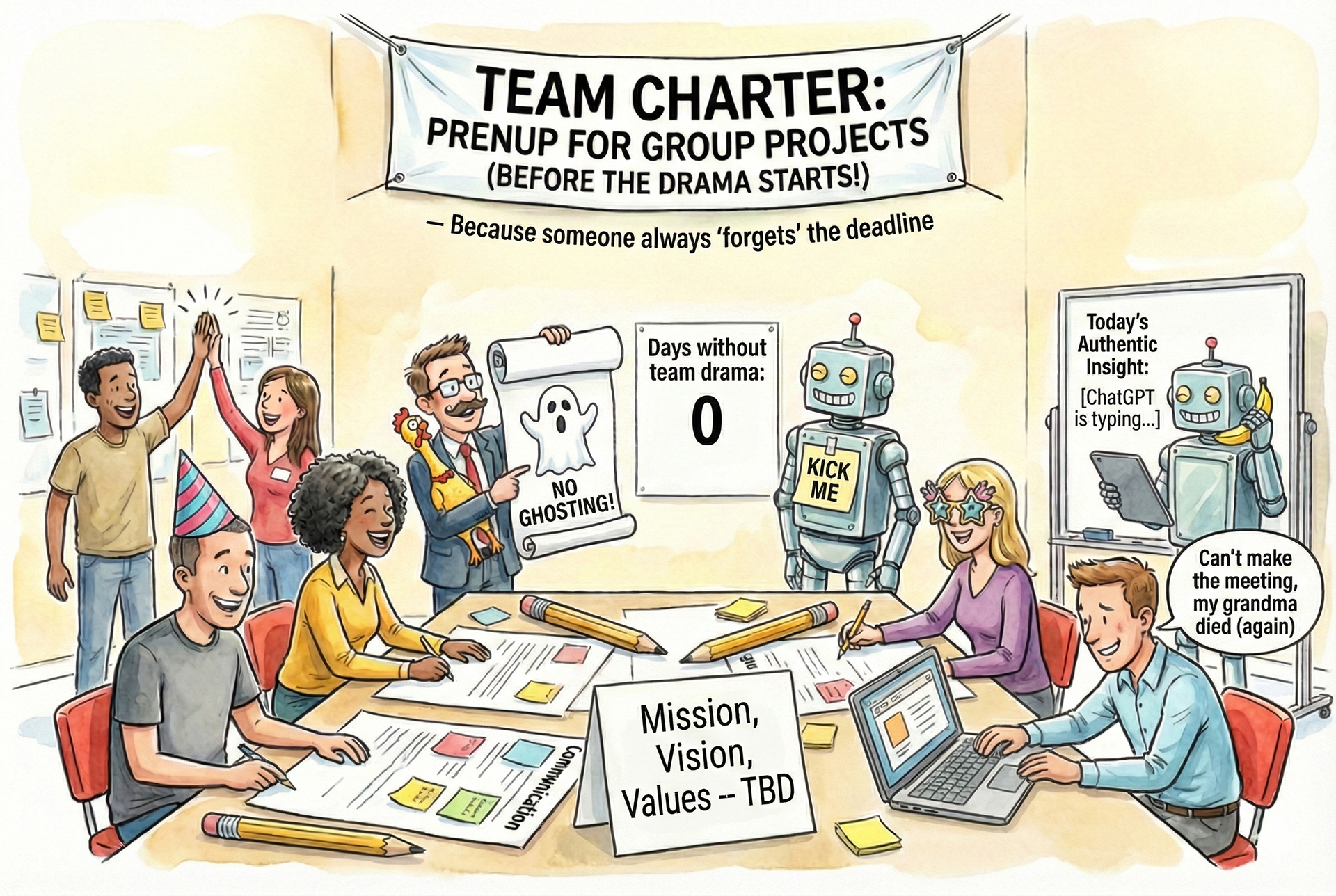
"A team charter is like a prenup for group projects - it's better to agree how you'll handle the drama before the drama starts." -- Not a Marriage Counselor, but probably should be
"The strength of the team is each individual member. The strength of each member is the team." - Phil Jackson
"None of us is as smart as all of us." - Ken Blanchard
"If you want to go fast, go alone. If you want to go far, go together." -- African Proverb
WHY CREATE A TEAM CHARTER
Great teams don't happen by accident -- just ask any championship sports team or successful startup. As Michael Jordan says, "Talent wins games, but teamwork and intelligence win championships."
Now, do you need a Team Charter?
Honestly, if you have a high-functioning team, probably not. As Steve Jobs says (our last lecture), great teams are self-policing. You are already motivated to do your job well and will keep each other accountable.
So, why am I asking you to create a Team Charter then? Because not all teams are high-functioning ones (If they were, group projects wouldn't have the "amazing" reputation they do among college seniors).
With that in mind your first assignment as a team is to create a Team Charter.
Now, I know, this might sound as exciting as reading the Terms and Conditions when you sign up for TikTok, but I think the process of creating a Team Charter is more valuable than the document itself.
Why?
First, it forces uncomfortable conversations early when things are still friendly and low stakes--e.g., what happens if someone misses a deadline and what happens if someone is MIA? Trust me--having this conversation in week 13, a few days before your actual presentation, is a lot more awkward.
Second, and more importantly, you get to clarify your expectations. As Simon Sinek observes, "A team is not a group of people who work together. A team is a group of people who trust each other." While a team charter is not going to magically create trust (that takes time), it can at least help you get started on figuring out who is responsible for what. In turn, you will have more clear expectations moving forward. What does a "team meeting" mean—a two-hour in-person session in the library, a quick 10-minute Zoom call, or a beer tasting event of [pick your favorite brewery]? What do you want to get out of this project as a group? What are your shared values?
In turn, when everyone is on the same page, trust is easier to follow.
Third, research shows that when you commit to something publicly, it creates psychological commitment (especially if it is in writing). In turn, you are more likely to follow through when your name is on the document and your signature at the end.
You can also think of your Team Charter as your insurance policy. What do I mean by this? Well, it's kind of like car insurance--you hope you will never need to use it, but it's there to help navigate common team challenges like the classic "I thought someone else was doing that" or "I thought we were using Slack to communicate", "I definitely sent this email ... I think" or [insert your favorite team drama story here].
In my experience, the best teams often forget their charter exists. And if you end up not using it during the semester, chances are you had a great team!
So let me finish with a quote from Vince Lombardi:
"Individual commitment to a group effort--that is what makes a team work, a company work, a society work, a civilization work."
In a sense, your team charter is your individual commitment to group effort this semester!
WHAT MAKES A TEAM EFFECTIVE?
So, how do you assemble a great team? And, is there a secret formula?
In 2012, Google's tried to answer precisely this question. They called it "Project Aristotle" (names after the greek philosopher who said that "the whole is great than the sum of its parts".
They ended up analyzing hundreds of teams, conducting hundreds of interviews, and eventually came to a somewhat surprising conclusion: who is on a team matters far less than how team members interact and structure their work.
The top predictors of team success were:
(1) Psychological safety - feeling safe to take risks and be vulnerable
(2) Dependability - completing quality work on time
(3) Structure and clarity - clear goals, roles, and execution plans
(4) Meaning - work that matters to the team
(5) Impact - belief that the work makes a difference
If you want to learn more, watch the video above (and below) and check out their article on Team's effectiveness [read here] [NY Times article about the project]
These are precisely the type of things I want you to think about as you work on your Team Charter!
For example, how do you create an environment of psychological safety, which Amy Edmondson, Harvard professor and leading expert on psychological safety, defines as: "a belief that one will not be punished or humiliated for speaking up with ideas, questions, concerns, or mistakes."
In my experience, who is on your team actually matters a lot.
This is not to say that the experiment above was wrong. But Google is a unique environment. Think about it, these are elite, highly vetted individuals — the cream of the crop. They've gone through rigorous hiring process that has already filtered for intelligence, motivation, work ethic, and cultural fit. When everyone in the sample is exceptional, it's not surprising that "who" stops being a differentiating factor. It's like studying NBA players and concluding that height doesn't matter for basketball success — well, everyone is already tall.
Unfortunately, you won't be working with Google engineers who have survived multiple rounds of interviews and coding challenges. In most real-world settings — including your project teams this semester — research consistently finds that individual factors do matter: personality traits, reliability, complementary skills, and yes, plain old work ethic.
So think of Project Aristotle's findings as necessary but not sufficient. Once you have the right people, then psychological safety, dependability, and clarity become the differentiators. But you still need to start with the right people.
What does it mean for you? Choose your teammates wisely (see Project Pitch tips), and use your Team Charter to establish the dynamics that make good teams great.
You can watch the videos below for some extra ideas how to tackle your team dynamics moving forward.
Why “slow productivity” is the key to great work and happy teams [read here]
Five dysfunctions of a team [watch here]
TEAM EXERCISE: Just DON'T Do It
You will do this in class with your team!
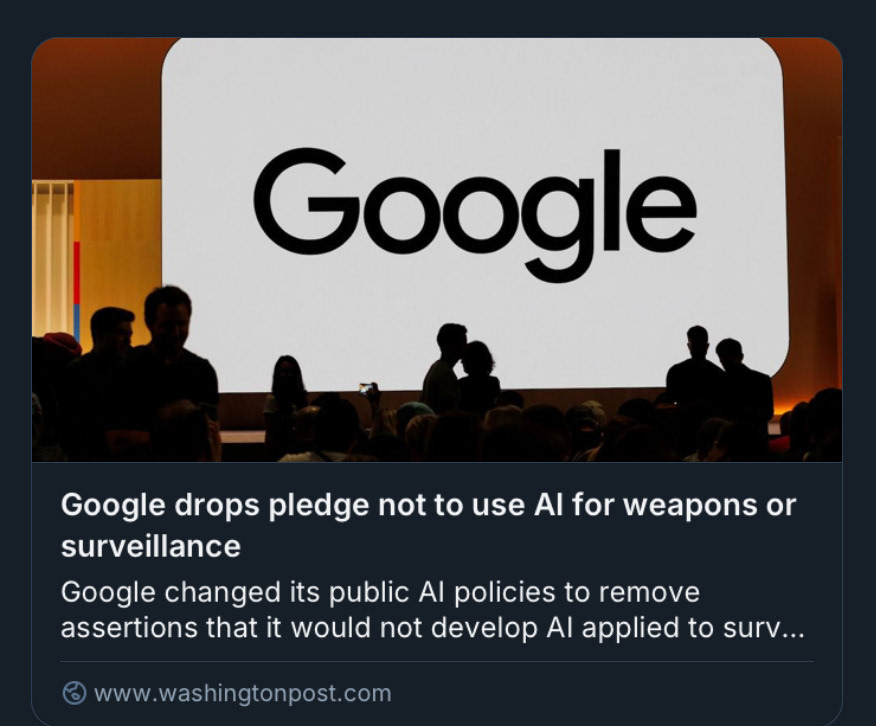
Note: This exercise was inspired by the news (Feb 4, 2025) that Google is dropping their pledge not to use AI for weapons and surveillance. 😈 Remember their unofficial logo (from 2001) "Don't be evil"?
Welcome to "Goo-ghoul: Do What Pays Well."
In this exercise, we will use "reverse thinking" (a classic creativity technique) to imagine the complete opposite of your company.
Why do this? Because sometimes the best way to understand what something IS is to understand what it is NOT. As a bonus, reverse thinking is a fun creativity technique that can help you break conventional thought patterns. So...
What if your company stood for the reverse of everything it represents today?
Research your company's mission, values, products, and target market (customers) ... and flip them completely upside down! (e.g., REI #OptOutside campaign becomes #JustStayInside, Nike's "Just Do It" becomes "Just Don't Do It" ... "Whole Foods" becomes "Empty Foods" with their new slogan: "If nature made it, we won't take it").
Be creative. Have fun. You have 20 mins.
Work with your team to prepare a short pitch on your reverse company. Include the following:
- Your reversed mission/slogan
- At least one "anti-product"
- Your new target customer
- A marketing tagline
Don't tell us the name of your company (let us guess).
Remember: The more serious your company is, the more fun it is to reverse!
EXAMPLE:
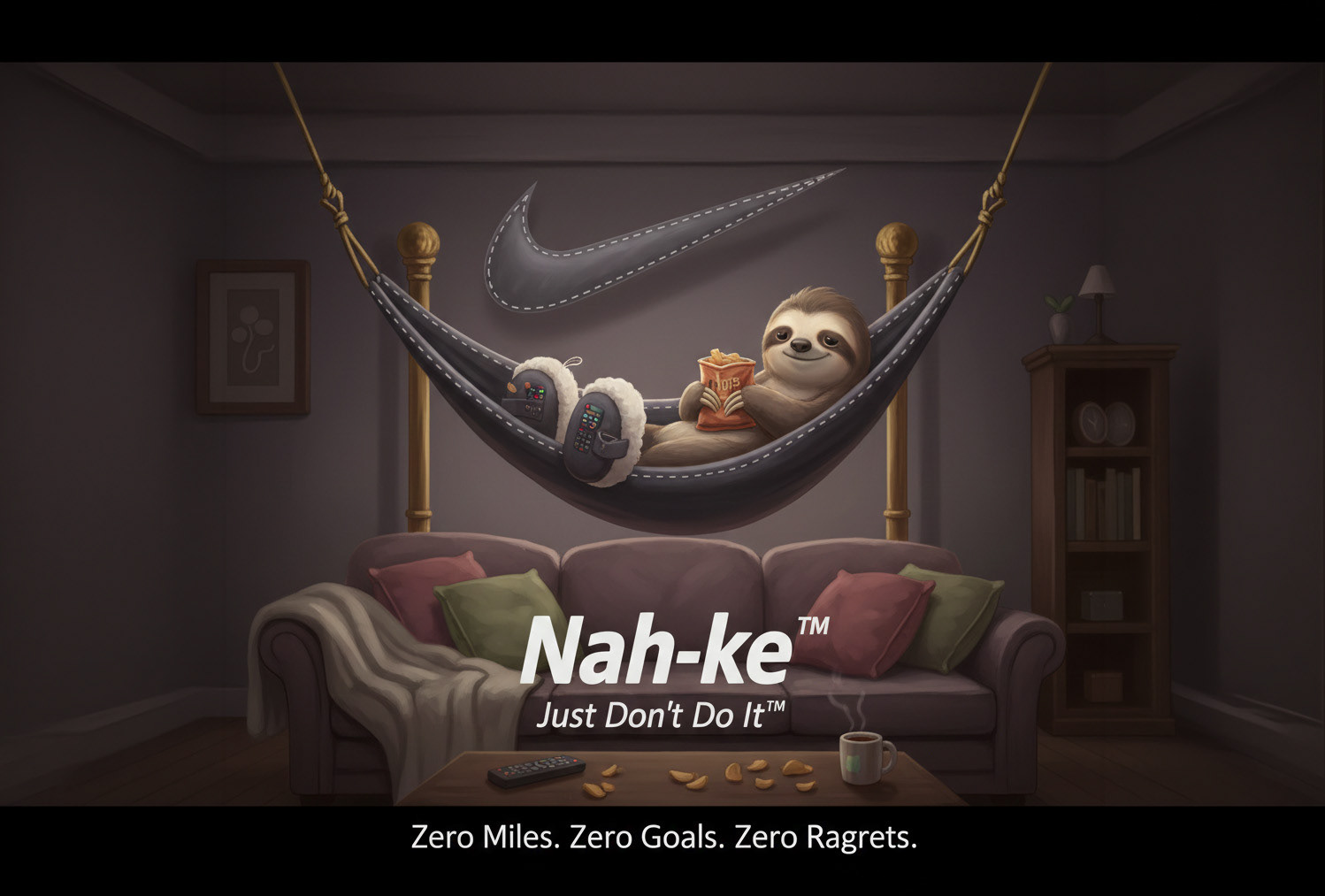
Nike → "Nah-ke" (pronounced "Nah-key")
Slogan: "Just DON'T Do It"
Values: Maximum comfort, zero effort. Cause you can never be spoiled enough. Why push yourself when you can push a button?
Product: "Couch Kicks" - The world's least athletic shoe, but also SOOO comfy. Scientifically designed to reduce steps by 50% (now with built-in TV remote holder).
Target Customer: Our market research shows 9 out of 10 sloths prefer our shoes.
Tagline: "Yesterday you said tomorrow... and you were right! In fact, why do today what you can put off indefinitely? Dreams can't fail if you never try!"
Marketing Campaign: "Zero Miles. Zero Goals. Zero Ragrets."
TEAM CHARTER
1. Download the Team Charter template [download here]
2. Complete it collaboratively during our designated time in class
3. Submit your Team Charter on Canvas (individually)
4. Be prepared to present your Team's Charter in front of the class for 5 mins and discuss your team's guiding principles.
While the template provides a strong foundation, make it your own. Study how successful organizations structure their teams. Innovate. The most effective teams don't just follow best practices - they create them.
Remember: Your charter is meant to evolve. Revisit and adjust it as your team learns what works best.
10 TOOLS TO IMPROVE GROUP PROJECTS
1. Otter.ai [website]
Find the best times to meet
2. Doodle [website]
3. When2Meet [website]
How will you communicate with each other
4. Discord [website]
5. Slack [website]
6. WhatsApp [website]
7. GroupMe [website]
Share screen recordings when you have questions
8. Loom [website]
9. Zoom/Team Recordings [website]
Share/Organize your research
10. Notion [website]
11. Miro [website]
12. Mural [website]
You can also use GoogleDocs.
Ok, that's 13 tools (wow!)