QUOTE OF THE DAY
"Would I rather be feared or loved? Easy. Both. I want people to be afraid of how much they love me." - Michael Scott (The Office)
"A goal without a plan is just a wish." - Antoine de Saint-Exupéry
"The greatest leader is not necessarily the one who does the greatest things. He is the one that gets the people to do the greatest things." - Ronald Reagan
"If you don't have a vision of where you go and if you don't have a goal where you go, you drift around and you never end up anywhere." - Arnold Schwarzenegger
"Leadership is an art of getting someone else to do something you want done because he wants to do it." - Dwight D. Eisenhower
"A good leader takes a little more than his share of the blame, a little less than his share of the credit." - Arnold H. Glasow
"The most powerful leadership tool you have is your own personal example." - John Wooden
"A true leader has the confidence to stand alone, the courage to make tough decisions, and the compassion to listen to the needs of others." - Douglas MacArthur
"A leader is best when people barely know he exists, when his work is done, his aim fulfilled, they will say: we did it ourselves." - Lao Tzu
Winning Hearts & Minds: The Art of Strategic Leadership
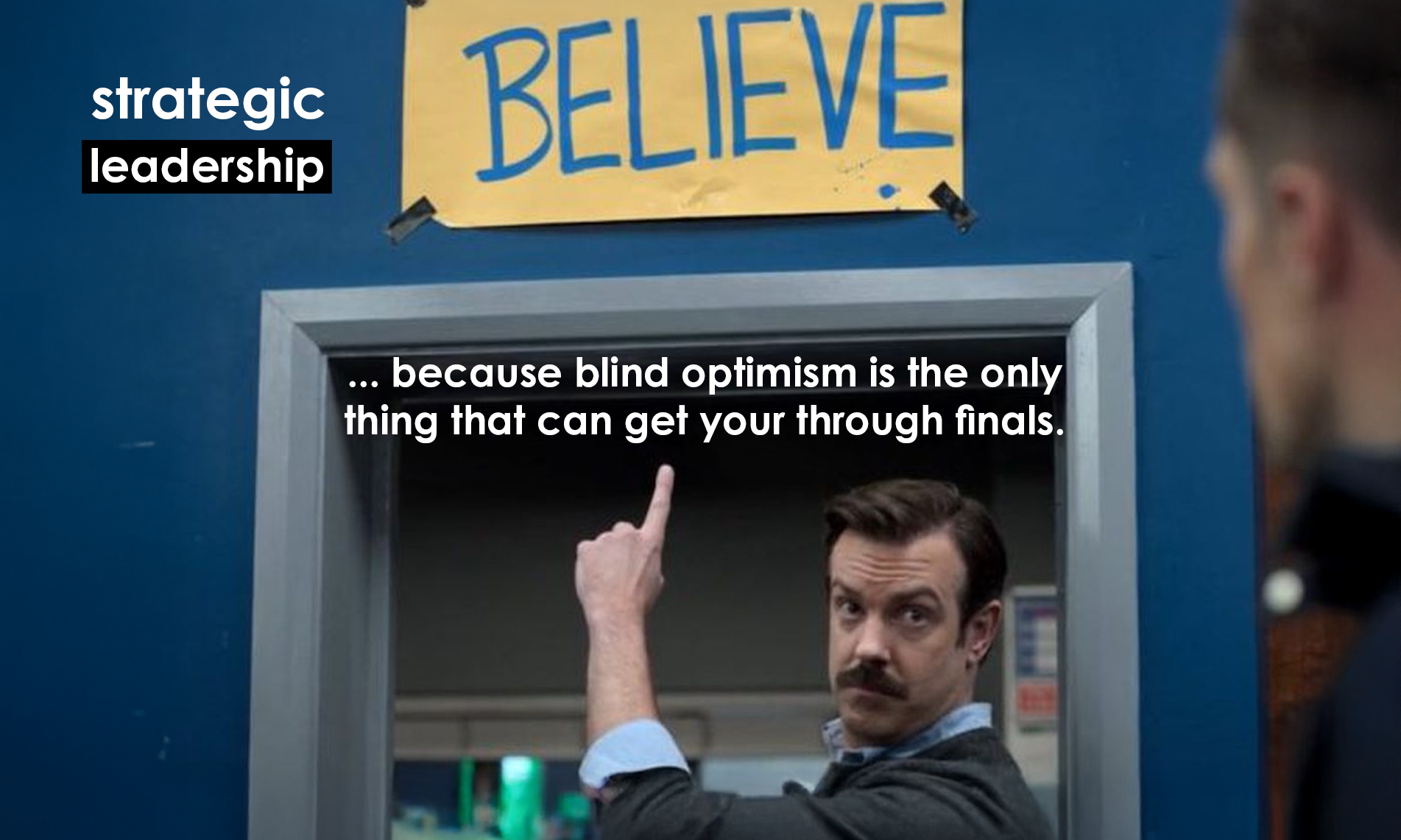
"Be curious, not judgmental" - Ted Lasso
Imagine that you've just been hired to manage a team that absolutely, positively does not want you there. Your expertise? American college football. Your new job? Coaching professional soccer—in England. The players resent you, the media mocks you, and even the team owner secretly hopes you will fail (that's why she hired you on the first place ... as a joke).
This is the absurd premise of "Ted Lasso," the award-winning show about an American football coach who, despite knowing almost nothing about soccer (or "football" as the rest of the world calls it), is recruited to manage AFC Richmond, a struggling English Premier League team.
What makes this fish-out-of-water story remarkable isn't just the comedy – it's how Ted's unorthodox leadership transforms a toxic team culture through genuine care, emotional intelligence, and unwavering optimism.
Be Curious, Not Judgmental
Perhaps one of the most powerful leadership lessons from Ted Lasso comes during a dart game against Rupert, the narcissistic ex-husband of the team owner (you can watch the scene above). Throughout the season, everyone has underestimated Ted as a simple-minded American who doesn't belong. As Ted steps up to throw what appears to be a hopeless final dart, he reveals something unexpected:
"You know, Rupert, guys have underestimated me my entire life. And for years I never understood why... Then one day I was driving my little boy to school, and I saw this quote by Walt Whitman. It said, 'Be curious, not judgmental.' I like that.
"So I get back in my car and I'm driving to work, and all of a sudden it hits me – all them fellas that used to belittle me, not a single one of them were curious. They thought they had everything all figured out, so they judged everything and they judged everyone. And I realized that their underestimating me... who I was had nothing to do with it. Because if they were curious, they would've asked questions. Questions like, 'Have you played a lot of darts, Ted?' Which I would've answered, 'Yes sir, every Sunday afternoon at a sports bar with my father from age 10 till I was 16 when he passed away.'"
Ted then nails the perfect shot, stunning everyone.
This scene brilliantly illustrates how judgment shuts down possibilities while curiosity opens them up.
The best leaders don't assume they know everything or everyone; they remain genuinely curious. They ask questions. They listen. They recognize the world is far more complex than their limited perspective can capture.
What would you do if suddenly placed in a leadership position where you lacked traditional credentials? Would you fake expertise? Rule with an iron fist? Or would you, like Ted, lead with curiosity, empathy, and an unwavering belief in people's potential to grow?
The Power of Humility: Leaders Who Look Out Windows and Into Mirrors
Do you know how many products are stocked in a typical Walmart?
Around 100,000.
In New York City, there are approximately 10 billion distinct products available.
It would take you 375 years just to count them all – not looking at the label and trying to figure out what these products are, just counting.
This staggering complexity is a world away from our hunter-gatherer ancestors, who dealt with perhaps 300 items in their entire lives.
Nobody today knows how to make even a simple pencil from scratch. We depend on vast networks of specialized expertise that no single person can fully comprehend.
This complexity means true leadership starts with humility – recognizing you can't possibly know everything or do it all yourself. The people around and below you are often more important than you are to achieving success.
Jim Collins discovered this counterintuitive truth in his landmark study of companies that made the leap from merely good to truly great (you can see the short video above). In examining 1,435 companies over 40 years, Collins and his team found that the most successful transformations were led by what he called "Level 5 Leaders" – people who blended extreme personal humility with intense professional will.
Consider Darwin Smith, who transformed Kimberly-Clark from a mediocre paper company into the leading consumer paper products company in the world. When asked by a Wall Street Journal reporter to describe his management style, Smith stared back through his thick black-rimmed glasses and, after an uncomfortable silence, simply said: "Eccentric." He then turned the conversation back to the company and its people – never himself.
When Collins' team interviewed Alan Wurtzel, who led Circuit City to outperform the market 18.5:1 over a 15-year period, they asked him to list the top five factors in his company's transformation. His number one factor? "Luck." When they pushed back, pointing out that his competitors had the same opportunities, Wurtzel insisted on crediting fortunate timing and excellent colleagues.
Collins called this pattern "the window and the mirror." Level 5 leaders look out windows to credit others, even attributing success to good luck when no specific person can be named. But when things go wrong, they look in the mirror, taking personal responsibility rather than blaming external circumstances.
Contrast this with comparison companies where leaders did exactly the opposite – claiming personal credit for successes while blaming failures on bad luck or external factors. Scott Paper's CEO Al Dunlap boastfully called himself "Rambo in pinstripes" and personally accrued $100 million for 603 days of work before selling off the company. Meanwhile, Kimberly-Clark under Darwin Smith's humble leadership beat Scott Paper and went on to outperform the general market 4.1 times.
When Underdogs Take Flight
The year is 1903. Theodore Roosevelt is president. The average worker earns about $200-$400 annually. And the race to achieve the first powered human flight has captured America's imagination.
Samuel Pierpont Langley seems destined to win this race. As secretary of the prestigious Smithsonian Institution and an assistant at Harvard's Observatory, he has impeccable credentials. The War Department believes in him enough to provide $50,000 in funding (millions in todays money). He assembles an elite team of the nation's brightest minds. The New York Times follows his progress religiously, treating him as a celebrity inventor. When Langley speaks, important people listen.
Meanwhile, in a humble bicycle shop in Dayton, Ohio, two brothers tinker away in obscurity. Orville and Wilbur Wright have no college degrees. Their flight experiments are funded by the modest proceeds from repairing bicycles. No newspapers chronicle their progress. No government grants fund their work.
By any conventional measure of leadership success, this shouldn't be a contest. Yet on December 17, 1903, on the windswept dunes of Kitty Hawk, North Carolina, it was the Wright brothers who achieved what Langley couldn't – the first controlled, powered flight of a heavier-than-air aircraft. Just days earlier, Langley's better-funded aircraft had plunged into the Potomac River during its test flight, becoming a public embarrassment.
What separated these leaders wasn't resources or credentials – it was purpose and perseverance. While Langley sought fame and fortune, the Wright brothers pursued a dream bigger than themselves. Their team worked with blood, sweat, and tears because they shared a vision of changing the world. They would crash five times before dinner and keep going, meticulously learning from each failure.
Most telling was what happened after the Wright brothers' success. Did Langley congratulate them and build upon their breakthrough? No – he simply quit. If he couldn't be first, if he wouldn't get rich or famous, what was the point? His leadership was ultimately about himself, not the mission.
This story reveals something profound that transcends both time and technology: Purpose-driven leadership inspires people to achieve the seemingly impossible, while self-serving leadership merely purchases temporary compliance.
Why Study Leadership? The Crisis and the Opportunity
Well, I hardly need to tell you that we are suffering from a crisis of leadership. Just spend an hour scrolling through Twitter/X posts from our political leaders, corporate executives, or public figures, and you will witness a masterclass in how not to lead. The finger-pointing, the blame-shifting, the prioritizing of quick wins over lasting impact – it's all there in an embarrassing display of egos.
This leadership vacuum isn't just annoying – it's expensive. When employees quit because of poor management (and half of Americans have done exactly that), companies lose between 50-200% of each departing employee's annual salary in replacement costs.
The mental health impact is even more concerning. A recent Gallup study found that the quality of management accounts for at least 70% of the variance in team engagement. In other words, your boss affects your well-being more than your actual job does.
But where there's crisis, there's opportunity.
The World Economic Forum's Future of Jobs Report consistently ranks leadership among the most crucial skills for career success in the coming decade. While technical skills can be automated or outsourced, the ability to inspire, align, and mobilize people remains distinctly human. As AI systems handle more routine tasks, leadership becomes not just valuable but essential.
Consider this: when was the last time someone's technical brilliance made you want to follow them? Now compare that to someone whose vision and values inspired you to give your best. Technical skills might get you hired, but leadership skills get you promoted.
The truth is that at some point – whether you aspire to it or not – you will lead others. It might be a formal role managing a team, or it might be the informal leadership that happens when others look to you for direction during uncertainty. The question isn't if you will be a leader, but what kind of leader you will be when the moment arrives.
In this section, we will explore several crucial leadership principles that separate merely adequate managers from truly transformative leaders. We will draw from Ted Lasso's playbook of relentless optimism, Arnold Schwarzenegger's iron-pumping perseverance, the Office's hilariously misguided incentive systems, and Jim Collins' research on what makes companies go from good to great.
Whether your ambition is founding a startup, managing a department, or simply leading a successful team project, these principles will serve as your foundation. And unlike many traditional leadership skills, these don't require an MBA or years of management experience – just a willingness to understand human psychology and motivation.
Because ultimately, leadership isn't about titles or authority – it's about inspiring others to achieve more than they thought possible. As Ted Lasso might say, "Taking on a challenge is a lot like riding a horse. If you are comfortable while you are doing it, you are probably doing it wrong."
REQUIRED READINGS
- Level 5 Leadership: The Triumph of Humility and Fierce Resolve [read here] [alternative link]
- What it takes to be a great leader [watch here]
FIVE KEY LEADERSHIP LESSONS
1. VISION WITHOUT EXECUTION IS JUST HALLUCINATION
Arnold Schwarzenegger didn't just wake up one day with seven Mr. Olympia titles, a Hollywood career, and the governorship of California. As he explains in one of his famous speeches (you can watch it above), "I felt that I was born for something special, for something unique, for something big." When he saw bodybuilder Reg Park on a magazine cover and learned that Park had leveraged his physique into a Hercules movie role, young Arnold had his lightbulb moment: "This is the blueprint for my life."
The first rule of leadership is having a compelling vision that gives meaning to the daily grind. As Arnold puts it, "When you have a goal, when you have a vision, everything becomes easy ... I'm shooting for gold. Every rep that I do gets me closer to accomplishing that goal."
But—and this is crucial—having a vision isn't enough. As Suzy Welch points out, "If you are a manager or a leader and all you do is dream big dreams and think and talk about the future in lofty visionary terms and you don't actually get anything done, everyone is going to hate you."
Steve Jobs didn't just have a vision for beautiful technology; he convinced people to follow him by framing it as something bigger. When recruiting John Scully from Pepsi, he didn't say, "Come work for a smaller, riskier company with less pay." He asked, "Do you want to sell sugar water for the rest of your life, or do you want to come with me and change the world?" (you can watch Scully's recollection of this moment above).
That's the difference between a goal and a vision—a vision gives meaning to work.
The key insight?
You need both vision and execution. To use Welch's musical metaphor: "You have to tell the drummer what the words of the song are about. You can't just give the drummer the music and tell him to hit it."
Ted Lasso exemplifies this when he approaches star player Jamie Tart, who famously shouts "Me! Me!" after scoring. Rather than demanding Jamie change, Ted aligns their goals: becoming a team player is presented not as a sacrifice but as Jamie's path to true greatness.
Without a compelling vision, your team is just doing tasks. Without execution, your vision is just a fantasy. Great leaders provide both the "why" and the "how," turning everyday work into meaningful progress toward something extraordinary. In other words, vision without execution is hallucination (allegedly one of Thomas Edison's most favorite sayings).
2. Carrots, Sticks, and Human Dignity: The Surprising Truth About What Motivates Us
Remember that episode of The Office where Andy Bernard tries to motivate his employees with a points system? (check out the short clip above!). Employees could earn points for doing their jobs better and redeem them for prizes such as a stuffed polar bear (15 points) or maternity shirt (55 points).
Unsurprisingly, no one cared—until Andy dramatically upped the stakes. For 500 points, he'd wear a dress to work. For 1,000 points, he'd run naked through the parking lot with a donut strategically placed, and for an eye-popping 5,000 points, he'd let his staff tattoo anything they wanted on the "stern of the old SS Bernard."
Suddenly, productivity exploded—even Stanley, famous for his "open-eye naps," got engaged.
This absurd scenario humorously captures what author Daniel Pink uncovered through extensive research: traditional "if-then" incentives often backfire spectacularly when tasks involve creativity or critical thinking
In one striking MIT study, researchers found that larger monetary incentives actually led to worse performance on tasks requiring even minimal cognitive skill. Skeptical of these results, they replicated the experiment in rural India, offering participants incentives worth nearly two months' salary—and the same thing happened. Higher incentives, worse outcomes.
What's behind this paradox?
As Pink explains, "For simple, straightforward tasks—algorithmic tasks where you just follow rules to reach the correct answer—carrots and sticks work perfectly. But when tasks get complicated, when they demand conceptual and creative thinking, those external motivators fail miserably."
Jim Collins's Level 5 leaders intuitively understood this. They didn't lean on flashy bonuses or threats to inspire action. Instead, they combined unwavering resolve with genuine humility, creating environments where team members felt connected to a meaningful purpose. Consider Darwin Smith, CEO of Kimberly-Clark, who didn't bribe executives to accept his radical decision to sell profitable mills. His clarity of vision and personal resolve sparked intrinsic motivation, driven by purpose rather than payoffs.
So what actually motivates us? Pink identifies three powerful drivers beyond basic financial security:
Autonomy – the freedom to direct our own work.
Mastery – the satisfaction from continuous improvement and skill development.
Purpose – the desire to contribute to something bigger than ourselves.
Steve Jobs didn't just motivate Apple employees with generous bonuses; he inspired them to "put a ding in the universe."
Pink summarizes it neatly: "We are purpose maximizers, not just profit maximizers." Great leaders know this and intentionally design workplaces to fulfill these deeper human motivations.
Think of the character Ted Lasso recognizing his player Sam Obisanya’s homesickness and thoughtfully celebrating his birthday. Ted isn't just being kind—he’s demonstrating leadership that honors individual humanity and deeper emotional needs.
Bottom line: If you're still relying exclusively on external rewards and punishments to motivate your team, you're treating them like, in Pink’s memorable phrase, "slower, smaller, better-smelling horses." The evidence is clear: carrots and sticks are limited to simple tasks. But for creativity, critical thinking, and innovation—the skills truly essential in today’s dynamic economy—leaders must nurture autonomy, mastery, and purpose.
Or, as Andy Bernard might say, sometimes motivating your team means putting your own dignity (and perhaps your rear end) on the line.
3. Make Everyone Feel Like They Matter
"Me? No one ever asks my name." - Nate the kit manager, Ted Lasso
The corporate world is like an iceberg. At the top, the C-suite executives bask in the spotlight, but the organization's success rests on the vast, often unseen mass beneath the surface—the people whose names don't appear in press releases.
Great leaders understand that everyone on their team matters—not just the stars, but every single person. This isn't just touchy-feely nonsense; it's practical leadership that gets results.
In Ted Lasso, we see this when Ted immediately learns and remembers Nate the kit manager's name—something no one else had bothered to do. The look of genuine surprise on Nate's face when Ted asks, "What's your name, by the way?" speaks volumes. Later, Ted demonstrates he wasn't just being performatively nice when he calls out, "You continue to impress, Nathan," remembering his name when others treat him as invisible. This seemingly small gesture begins Nate's transformation from overlooked towel boy to valued team strategist. By the end of the season, Nate is confidently delivering the pre-game speech to the entire team.
Jim Collins' research on Level 5 Leadership found that the most effective leaders possess a paradoxical blend of personal humility and professional will. These leaders "channel their ego needs away from themselves and into the larger goal of building a great company." When Darwin Smith, the Level 5 CEO of Kimberly-Clark, was asked by a Wall Street Journal reporter to describe his management style, he stared back awkwardly through his thick black-rimmed glasses and finally said just one word: "Eccentric." Then he turned the conversation back to the company and its people—never himself.
It's not just about being nice. It's about recognizing that human dignity and performance are inextricably linked.
The key insight?
People don't care how much you know until they know how much you care. A common mistake of new managers is selectively giving attention only to those they perceive as important or influential. This creates a toxic culture where people feel like tools rather than valued team members.
As Simon Sinek points out, the test of a true leader is simply this: "If you ask somebody how their day is going, you actually care about the answer."
If people feel invisible, they act invisible. If they feel valued, they deliver value. And no, that "Employee of the Month" parking spot isn't cutting it. Real recognition means taking a genuine interest in people at all levels of your organization, remembering their names, soliciting their ideas, and giving them credit (especially when they are not in the room). In a world where employees increasingly want meaning in their work, this isn't optional—it's the foundation of effective leadership.
4. Create Lieutenants, Not Followers
"Nate, I have a real tricky time hearing folks that don't believe in themselves, so I'm going to ask you real quick again: Do you think this idea will work?" - Ted Lasso
Great leaders don't just create followers—they develop other leaders. This isn't just noble—it's practical. You can't scale your impact without multiplying leadership throughout your organization.
In Ted Lasso, we see this when Ted pushes Nate to share his tactical ideas with the team. Ted doesn't just give Nate a token pat on the back; he forces Nate to own his expertise: "I'm going to ask you real quick again: Do you think this idea will work?" Then Ted has Nate deliver the pregame talk himself, transforming the invisible kit manager into a respected tactician.
This philosophy mirrors what Phil Jackson, winner of 11 NBA championships as a coach, practiced: "I always tried to foster an environment in which everybody played a leadership role, from the most unschooled rookie to the veteran superstar... When I did that, it paradoxically strengthens my role as a leader."
Google institutionalized this approach with their famous "20% project," where employees could spend 20% of their time working on what they thought would most benefit Google—resulting in innovations like Gmail and Google News.
Jim Collins found that Level 5 leaders actively set up their successors for success. Unlike ego-driven leaders who sabotage potential successors to appear irreplaceable, Level 5 leaders want their organizations to be even more successful after they are gone.
As Adam Bryant, who has interviewed over 1,000 CEOs, notes: "The very best people at the top of teams or organizations are doing a little bit of managing and a little bit of leading." And part of that leadership is developing those same capabilities in others.
The key insight? A sign of your leadership quality isn't how indispensable you are—it's how well your team functions when you are not there. As Dwight D. Eisenhower said, "Leadership is the art of getting someone else to do something you want done because he wants to do it."
If you're afraid to develop strong leaders beneath you because they might threaten your position, you are already failing. The greatest compliment to a leader isn't "we couldn't do it without you" but "look what you enabled us to accomplish."
5. Balance Unflinching Reality with Unwavering Optimism
"We are broken. We need to change." - Ted Lasso
Great leaders balance two seemingly contradictory traits: clear-eyed acceptance of current reality AND unwavering belief in a better future. This is perhaps the hardest leadership skill to master.
In Ted Lasso, after a devastating loss and relegation to a lower league, Ted acknowledges the brutal reality while maintaining an inspiring vision: "So the next year we get ourselves a promotion, which looks good on any resume. Then we come back to this league and we do something that no one believes we could ever do—win the whole *** thing."
Jim Collins found this same duality in his Good to Great research, calling it the "Stockdale Paradox" (named after Admiral James Stockdale, a Vietnam POW who observed that optimists without realism often died first in captivity). The paradox is: "You must maintain unwavering faith that you can and will prevail in the end, regardless of the difficulties, AND at the same time have the discipline to confront the most brutal facts of your current reality, whatever they might be."
Arnold Schwarzenegger embodies this principle throughout his career. When critics said his body was too bulky for Hollywood, he didn't deny the criticism—he acknowledged it and maintained his vision anyway. "I didn't listen to those losers," as he puts it. Even with his accent, which many said would prevent him from becoming a leading man, he found a way to turn these supposed liabilities into assets. In the Terminator, director James Cameron later said, "If Arnold wouldn't have had that accent and talked like a machine, I think the movie wouldn't have worked."
The paradox extends to decision-making as well. As Suzy Welch notes, "People hate making hard calls because when you have put your name with the decision and then it bombs, your name's on it." But avoiding decisions paralyzes organizations. The solution? Embrace reality, make decisions, and when they're wrong, own it publicly: "The respect you get for saying, 'I made that mistake. I own it. This is what we learned' is unbelievable."
The key insight? Leaders must simultaneously hold two truths: an honest assessment of where you are AND an inspiring vision of where you are going. Deny either one, and you fail.
If your team thinks you are detached from reality or secretly doesn't believe your optimistic vision, you've already lost them. As Bryant notes about CEOs: "The first skill you need to have is the ability to simplify complexity. Take all the things that are complicated in the world, your industry, your company, and boil it down to a simple message that you can convey to all your employees that they will understand and remember."
Remember, as Arnold might say in his thick Austrian accent: "Having a vision without execution is just a hallucination." Or as Ted Lasso puts it more simply: "Taking on a challenge is a lot like riding a horse. If you're comfortable while you're doing it, you're probably doing it wrong."
6. Consistency Over Intensity: The True Path of Leadership
Just as we have explored how Ted Lasso's curiosity and Jim Collins' humble leaders shape transformative organizations, there's one final leadership principle that ties everything together – one that explains why some leaders create lasting impact while others create only temporary results.
Leadership isn't an event. It's not a seminar, a certificate program, or a dramatic speech that rallies the troops in a moment of crisis. True leadership operates on a principle beautifully articulated by Simon Sinek: consistency always trumps intensity.
Consider this analogy: When you fall in love with someone, can you pinpoint the exact day it happened? Can you measure the precise metric that tipped the scales from "not love" to "love"? Of course not.
As Sinek explains:
"When you met her, you didn't love her. Now you love her, right? Tell me the day the love happened. It's an impossible question – but it's not that love doesn't exist. It's that it's much easier to prove over time."
The same applies to leadership. Many aspiring leaders approach their role with bursts of intensity – the motivational team offsite, the flashy recognition program, the dramatic company-wide initiative. These are the leadership equivalent of remembering Valentine's Day or an anniversary – nice gestures, but not what creates deep bonds.
What truly matters are the small, consistent actions performed daily:
Asking team members how they're doing and actually listening to their answers. Acknowledging someone's contribution before checking your phone. When you've had an amazing day but your colleague has had a terrible one, putting aside your good news to truly hear their struggles. Demonstrating the values you espouse even when inconvenient or no one is watching.
These seemingly insignificant moments might appear pointless in isolation. Like brushing your teeth for two minutes – a single instance does nothing. Going to the gym for nine hours once doesn't get you in shape. But doing these small things consistently, day after day, creates something profound.
Three-star Marine Corps General George Flynn offers a beautifully simple test for leadership that captures this principle: "If you ask somebody how their day is going, you actually care about the answer." Not the rushing "How are you? Sorry, gotta run to a meeting," but the genuine pause to connect with another human being.
Over time, this consistency transforms mere professional relationships into something deeper. In ordinary companies, people have colleagues and co-workers. In extraordinary organizations – like the military and the very best businesses – people have brothers and sisters.
As Sinek explains: "If you really have a strong culture, people will think of each other like brothers and sisters. They will bicker, but the love doesn't go away. And if anyone from the outside threatens one of them, they will face a unified front."
This is the profound difference between people saying "I like my job" and "I love my job." The former means the challenges are interesting, the pay is good, and the people are nice. The latter means "I don't want to work anywhere else. I don't care how much someone else might pay me. I'm devoted to the people here and care about them as if they were my family."
Creating this kind of environment doesn't happen through grand gestures or charismatic speeches. It happens through the cumulative effect of consistent, genuine care – executives who view themselves as parents responsible for developing their people, celebrating their successes, and helping them achieve more than the leaders themselves could imagine.
So as you consider your own leadership journey, remember that while moments of inspiration are valuable, leadership excellence is ultimately built in the quiet moments when no one is watching. It's found in the daily discipline of small actions that, over time, create trust so deep and cultures so strong that people will walk through fire for each other.
Don't be discouraged if you can't immediately measure the impact of your leadership efforts. Like love, fitness, and all meaningful pursuits in life, the most powerful forces don't announce their arrival with trumpets and metrics. They reveal themselves gradually through the accumulated evidence of lives changed, teams unified, and organizations transformed.
That's the ultimate lesson of strategic leadership – not the dramatic moments that make headlines, but the consistent patterns that make history.
OPTIONAL READINGS
- Time is the scarcest resource for CEOs [watch here]
- How People Describe Working for the Most Powerful Leaders on Earth [read here]
- The importance of having a vision by Arnold [watch here]
- Be curious, not judgmental, Ted Lasso [watch here]
- How to get people to work harder, The Office [watch here]
- TED talks on leadership [watch here]
- What makes a great leader [watch here]
- Leadership explained in 5 mins [watch here]
- Elon Musk’s challenge to management thinking [read here]
- What Elon Musk Can Learn from Steve Jobs' Return to Apple [read here]
Classroom Exercise: Heroes vs. Villains of Leadership
Work with a partner to create a short PPT presentation that contrasts effective and ineffective leadership styles.
First, think of a leader (a breakthrough entrepreneur, a teacher, a friend, a movie character, or someone in your family) who has had a significant impact on your life and inspired you. Analyze their key qualities and how they've impacted others. What makes them a good leader?
Next, identify a counterexample – someone who demonstrates poor leadership. This can be a real person or fictional character.
Together, create a 5-minute presentation that contrasts these two leadership styles. Include brief introductions of both leaders, their key qualities, concrete examples of their leadership in action, and the impact they had on others.
Your presentation should have 5 slides maximum and address this reflection question: What one leadership quality from your "hero" do you most want to develop in yourself, and how might you practice it consistently?