QUOTE OF THE DAY
“Knowing others is intelligence; knowing yourself is true wisdom. Mastering others is strength; mastering yourself is true power.” - Lao Tzu
"Late fees weren't the only thing overdue for analysis." - Blockbuster (probably)
"In order to change the world, you have to get your head together first." - Jimi Hendrix
"Connecting people—but disconnecting strategy from reality." - Nokia (most likely)
"You can't build a reputation on what you are going to do." - Henry Ford
"Knowing your own darkness is the best method for dealing with the darknesses of other people." - Carl Jung
"A man who knows himself can step outside himself and watch his own reactions like an observer." - Adam Smith
THE THERANOS SYNDROME: WHEN INTERNAL ANALYSIS GOES MISSING
Imagine raising $945 million from some of the most prestigious investors, landing a valuation of $9 billion, and gracing the cover of Forbes as "the next Steve Jobs." Sounds pretty sweet, right? Now imagine all of this crashing spectacularly because your entire technology was built on nothing more than wishful thinking and a fancy pitch deck.
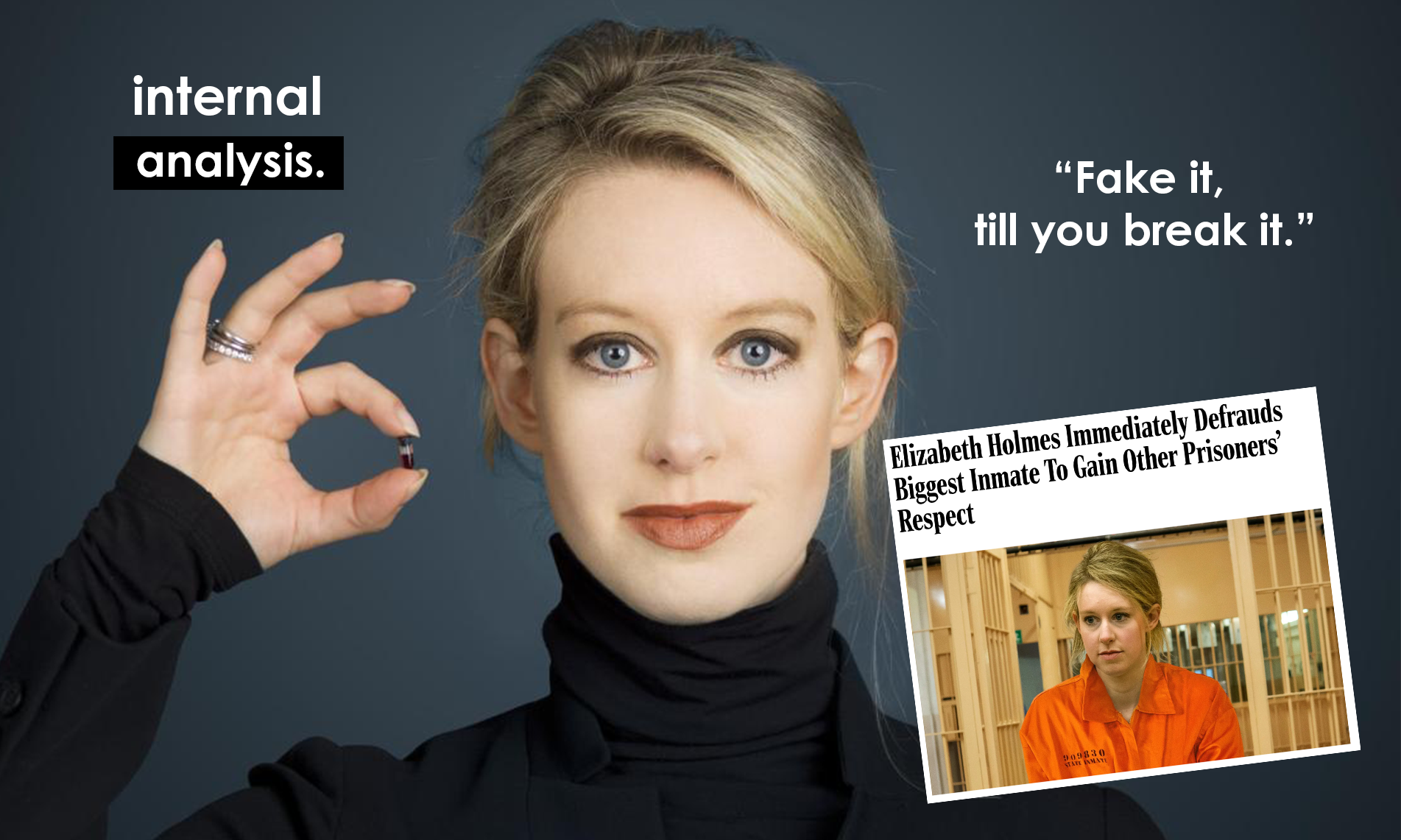
This is the story of Theranos, a company that was supposed to revolutionize blood testing with technology advertised to conduct numerous tests using just a few drops of blood. Yet, a company that is now a cautionary tale of why internal analysis matters—so much so that founder Elizabeth Holmes, once lauded as the youngest self-made billionaire in the US, is currently in jail (you can watch the video above or a short intro).
Companies don't usually implode overnight because of external forces alone; often, the rot starts from within. Theranos didn't fail because it couldn't compete or adapt—it failed because of internal factors: poor governance, unethical leadership, and a business model built entirely on hype rather than actual capabilities. If anyone at Theranos had stopped to honestly assess their internal environment, they would realize their product was less groundbreaking innovation and more "science fiction cosplay."
** As a side note, an equally interesting question here is how Elizabeth Holmes was able to scam so many experienced investors and what this tells us about the investors too. It also invites us to reconsider Silicon Valley's celebrated 'fake-it-til-you-make-it' ethos and whether such a philosophy ultimately serves innovation or undermines it.**
But Theranos isn't alone in fumbling internal analysis. Blockbuster had every advantage: market dominance, brand recognition, and resources galore—but internal complacency turned a movie rental giant into a museum exhibit. Nokia had the world at its fingertips but lost it by disconnecting its strategy from market reality. And let's not even get started on FTX—where "internal controls" meant asking your roommate if it was okay to move billions of dollars around.
As Lao Tzu says, "Knowing others is intelligence; knowing yourself is true wisdom." Internal analysis is when you move from intelligence to wisdom. It's about taking an honest look in the mirror and recognizing your strengths, weaknesses, and blind spots.
In this section, we will explore how to systematically examine a company's internal environment, so you can avoid the embarrassing fate of becoming the next Theranos or Blockbuster. How do we know if we will succeed? Well, if your company's downfall becomes a Netflix documentary, you are probably doing internal analysis wrong. In that case, don't mention to anyone where you learned the basics.
UNDERSTANDING INTERNAL ANALYSIS
When you hear "internal analysis," your brain probably jumps straight to frameworks like SWOT, VRIO, or Value Chain Analysis. And yes, these frameworks often feel about as insightful as saying, "Water is wet," or "Fire is hot." We get it—asking a company to list its strengths and weaknesses seems pretty obvious. But if it's so simple, why did Theranos, Blockbuster, and FTX fail so spectacularly?
Internal analysis is a bit like setting up your dating profile. Sure, you can tell everyone you are adventurous, hilarious, and love doing the dishes. But are you actually climbing mountains every weekend, or did you just walk uphill once and call it a day? Honesty matters—otherwise, you are headed for a lot of disappointing coffee dates. Just as overstating your hobbies might attract the wrong person, overstating your company's strengths or downplaying its weaknesses can lead you into strategic dead-ends.
Here is the honest truth: internal analysis isn't about checking boxes on a SWOT chart or reciting jargon from a strategy textbook. It's about taking a brutally honest look at what your company actually does well, admitting where you are falling short, and aligning what you say with what you can actually do. It's a corporate reality check—are you genuinely as innovative as your website claims? Do you truly have the resources to chase your ambitious goals? Or are you, like Theranos, putting lipstick on a pig and calling it a unicorn?
What about those fancy frameworks like VRIO or SWOT. Here's a fun fact: real-world entrepreneurs rarely, if ever, consciously apply these frameworks. Jerry Murrell didn't sit down at Five Guys and ponder, "Hmm, do our fresh, hand-cut fries fulfill VRIO criteria?" He simply said, "Let's make damn good burgers and fries." Sara Blakely didn't sketch out a SWOT analysis before inventing Spanx—she just wanted to fit better into white pants without visible underwear lines.
Does that mean these frameworks are pointless?
Not quite. Frameworks like SWOT and VRIO are great for clarity, communication, and keeping you honest. They are like strategic "training wheels," helping you learn to ask better, deeper questions and avoid blind spots. Think of them as your corporate BS detectors—there to gently whisper in your ear, "Hey, maybe we are not actually revolutionizing health care with a fancy black turtleneck and slick presentations alone."
If Elizabeth Holmes had stopped for a moment and used VRIO honestly—"Do we truly have this rare capability, or are we just good at Photoshop?"— she might have avoided becoming the star of an HBO series (at least you can watch it for extra credit!). So, yes, while successful entrepreneurs don't explicitly use SWOT or VRIO daily, implicitly, they embody what these frameworks try to teach: play to your real strengths, acknowledge your weaknesses, and never fall for your own hype.
Ultimately, internal analysis is about knowing yourself and making sure your ambitions don't sprint ahead of your actual capabilities. Because as Henry Ford put it perfectly: "You can't build a reputation on what you are going to do." Actions matter more than promises, especially when you would rather not star in the next Netflix documentary about corporate failure.
WHY INTERNAL ANALYSIS IS SO HARD
Most companies think they are great at internal analysis. It's similar to how everyone claims they are a great driver, even though statistically that's impossible. Delusional self-assessment isn't just a personal issue—it's a corporate epidemic. WeWork believed it was worth $47 billion while burning cash faster than a trust fund kid in Vegas (you can watch the short video above). Blockbuster thought DVDs would never go out of style, even as Netflix was taking over. And BlackBerry stubbornly held onto physical keyboards as their market share circled the drain.
COMMON INTERNAL ANALYSIS PITFALLS
Several cognitive biases make internal analysis especially challenging (we will talk about cognitive biases in much greater detail later in the semester), but here are a few:
The Confirmation Bias Trap
We naturally seek information confirming what we already believe. It's why Blockbuster executives could look at Netflix's DVD-by-mail service and shrug it off as "just a tech nerd thing." And why your uncle confidently reposts Facebook articles he agrees with politically but immediately labels anything contradictory as "fake news."
The WeWork Delusion
Adam Neumann positioned WeWork as a revolutionary tech startup reshaping the future of office spaces. In reality, they were mostly subleasing desks with free beer. Slick presentations aren't the same as actual capabilities—ask yourself: Am I hyping my skills and hoping reality catches up? Yet, appearances do matter (a key takeaway from WeWork and Theranos). So maybe beautiful slides deserve a place in your skillset after all.
The Kodak Syndrome
Sometimes your greatest strength can blind you to change. Kodak was so dominant in film photography that they overlooked digital—even though their own engineers invented it. Yesterday’s success can easily become tomorrow’s liability. Regularly challenge your assumptions; what worked before may not work tomorrow. We are seeing this in higher education right now, as AI reshapes what skills will truly matter in the future.
The "Yes-Person" Problem
Theranos and Boeing both suffered from corporate echo chambers where nobody dared deliver bad news. If you are a leader who hasn't heard any tough truths lately, you might be surrounded by terrified yes-people, not great employees. Seek honest feedback—even if it stings.
THE POWER OF RADICAL TRANSPARENCY
Honest self-assessment is difficult because corporate cultures rarely reward brutal honesty. Saying, "Actually, we are not that great at this," doesn’t typically get you a promotion. Instead, executives gather yes-people faster than influencers chase viral TikTok trends. Combine these biases with our natural aversion to uncomfortable truths, and you've got a perfect storm for strategic self-deception.
One way to address corporate delusion is through radical transparency—a concept popularized by Ray Dalio, founder of Bridgewater Associates, one of the most successful hedge funds in the world. Dalio argues that radical transparency, where people openly discuss mistakes and weaknesses, leads to better decisions and stronger organizations (You can check out his TED Talk for more insights on this.)
Radical transparency isn't easy. It means confronting truths that are uncomfortable or even painful. Do you really want your coworkers pointing out your flaws openly? Can you handle being told your "brilliant idea" isn't actually that brilliant, that your presentation was boring, that your appeared unprepared? While emotionally challenging, radical transparency builds resilience, trust, and accountability, creating an organization that's far more likely to succeed.
Would radical transparency have saved Theranos or Blockbuster? That's the million-dollar question—or in Theranos' case, the 9 billion dollar question. Most likely not.
The problem with internal analysis isn't just that it's hard; it's that the people most in need of it are often the least receptive to it. Elizabeth Holmes didn't want transparency; she actively punished whistleblowers. Blockbuster executives weren't interested in hearing that their business model had an expiration date.
No framework, no matter how brilliant, can overcome willful blindness or entrenched denial. This is why internal analysis remains more art than science, more aspiration than reality for many organizations.
Yet some companies do successfully confront their failures head-on. Amazon swiftly abandoned its failed Fire Phone, openly learning from mistakes to redirect its efforts toward the hugely successful Echo and Alexa products. Similarly, Netflix publicly admitted missteps with their Qwikster fiasco, quickly reversing course in response to customer criticism—demonstrating humility that ultimately preserved their reputation and fueled future success.
KEY FRAMEWORKS FOR INTERNAL ANALYSIS
You should already be familiar with the basic frameworks of internal analysis from your previous business classes. If you need a refresher, you should read chapter 4 from the textbook [read here].
Shortly, the chapter covers:
VRIO Framework (Value, Rarity, Imitability, and Organization). Pretty intuitive (you can watch the video below on how apple is organized around innovation).
- How apple is organized around innovation [watch here]
The Resource-Based View (RBV). Why some companies outperform others with similar external conditions
Core Competencies vs. Core Rigidities. When your greatest strength becomes your greatest weakness (you can also watch the short video above).
The Value Chain. Mapping where your company actually creates value (and where it doesn't)
OPTIONAL READINGS
- How to build mental strength [watch here]
- To find work you love, don't follow your passion [watch here]
- Know your strengths [read here]
- Stop overdoing your strengths [read here]
CLASSROOM EXERCISE
INTERNAL ANALYSIS
You should already have a solid understanding of your company's business model, market position, and external environment from previous analyses. Now, the focus shifts inside the organization. You will analyze your company’s resources, capabilities, and overall strategic strengths and weaknesses.
What You Need to Get Started
1. Your Company’s 10-K Report (you should already have it).
2. Access to Abacus.ai (or similar AI dashboard tool).
3. FinChat for financial data and ratio analysis.
4. ChatGPT/Claude/Perplexity for secondary research, brainstorming, or clarifications.
5. Any competitor 10-Ks or industry benchmarks for comparison.
Note: In the real world, internal analysis often combines quantitative (financial metrics, operational data) and qualitative data (leadership, culture, brand, intellectual property). Obviously, getting some of this information is challenging, so in a sense we are bootstrapping the whole process.
Before You Start
Review your External Analysis findings. Write down any key trends or threats that might require strong internal capabilities to address.
Revisit your company’s 10-K focusing on sections related to:
1. Business Overview
2. Management Discussion & Analysis (MD&A)
3. Risk Factors (already touched on)
4. Segment Reporting
5. Footnotes on intangible assets (patents, brand, goodwill, etc.)
Upload the 10-K into Abacus.ai and ask it to create an interactive dashboard focusing on:
- Key resources (both tangible and intangible)
- Core capabilities (e.g., technology, supply chain, brand strength)
- Any references to synergy or cross-business unit advantages if your company has multiple segments.
- Ask Abacus.ai (or another AI tool) to identify recurring themes in the 10-K that highlight the company’s unique internal strengths or potential weaknesses.
Slide 1: Resource Audit (Tangible and Intangible Resources)
1. Identify Key Tangible Resources
- Physical assets (plants, equipment, supply chain networks)
- Financial assets (cash, investments)
- Human resources (number of employees, specialized skill sets)2
2. Identify Key Intangible Resources
- Patents, trademarks, IP
- Brand equity, customer loyalty
- Proprietary technology, data, or algorithms
3. Create a simple table that list the type of resource, short description and strategic importance.
Resource Type Description Strategic Importance (1-5)
Tangible
Intangible
TIPS: You can upload the 10-K report into ChatGPT or Abacus.ai and ask "Based on this 10-K report, identify the main tangible and intangible resources for [Company X]. Which are central to the company's competitive advantage? Are there any hidden strengths competitors lack?"
TIP2: Focus on assets and capabilities the company itself highlights in earnings calls and investor presentations -- these often reveal what leadership considers most valuable. Specifically, once you identify the resources from the 10-K report, upload the last 2-3 earning calls into abacus.ai (or ChatGPT) and ask them to evaluate which are the most critical resources that the leadership of the company finds most valuable.
Slide 2: VRIO Analysis
VRIO stands for Valuable, Rare, Inimitable, and Organized. This framework helps identify if a resource/capability can lead to sustained competitive advantage.
1. Pick 2-3 resources/capabilities from Slide 2 that you believe are the company's core competencies/distinctive capabilities (these are the type of resources that drive lasting competitive advantage)
- Make sure you have at least one tangible and one intangible resource (you can do more if you think they are interesting/important and you have time).
2. Evaluate each of these resources using the VRIO framework.
- You need to provide strong evidence behind your evaluation, backing it up with specific data (quotes, articles, statistics, demonstrations). In other words, you are not just making empty claims, but you are proving them! (see below)
3. Present supporting evidence
- Demonstrations (e.g., you argue that company X has a great app, show us what you mean by this and why it is better than competitors).
- Quotes/Data from the 10-K (e.g., you argue that the technology platform is "rare" you can cite a line from the 10-K that describes the uniqueness of the R&D investment).
- CEO statements from earnings call (you already downloaded those from FinChat) and can run them through ChatGPT.
- Real world examples (e.g., if you argue that brand recognition is an advantage, show a relevant ad campaign screenshot, a brief commercial, or even poll classmates: “Have you seen or used this brand?” and try to find the brand value of the company)
- Statistics and comparisons (e.g., if you say a resource is inimitable, provide data on how much competitors would have to spend or how long it would take them to catch up).
4. Be specific.
- If you say "a brand is strong", show how and why it is strong. For example, Forbes publishes a ranking for the most valuable brands: https://www.forbes.com/powerful-brands/list/
- If you’re claiming a high R&D investment is both valuable and rare, cite actual R&D spend versus competitors.
Slide 3: Value Chain Analysis
A company’s value chain consists of the primary and support activities that transform inputs into products/services and deliver them to customers. Traditionally, it includes inbound logistics, operations, outbound logistics, marketing & sales, and service, plus support activities like HR, technology, and procurement.
It will be overwhelming to cover each one of these aspects of the value chain, so we will only focus on the Marketing & Sales component (one of the primary activities). Marketing is a core driver of brand awareness, customer acquisition, and revenue (small improvements here can lead to outsized impact on competitive advantage).
Benchmarking simply means studying how other companies execute similar activities and borrowing best practices to enhance your own performance (If Ben & Jerry’s wants to strengthen its marketing, it might benchmark Blue Bell and Häagen-Dazs to see how they run social media campaigns or create memorable ads, then incorporate the best ideas into its own strategy).
Marketing Benchmarking
1. Review Your Company’s Marketing
- Website (clarity, design, and ease of navigation)
- Social Media (posting frequency, content quality, follower engagement)
- Advertisements (memorability, brand consistency, effectiveness)
2. Perform the Same Review for Two Competitors
- Pick two direct competitors.
- Look at their website, social media, and ads with the same criteria
3. Assign Grades (A-F) and Explain
- Create a table with three rows (Your Company, Competitor 1, Competitor 2) and three columns (Website, Social Media, Ads).
- Give one letter grade (A-F) per column for each company, resulting in 9 total grades.
- Briefly explain why you gave each grade.
4. Propose Two Strategic Recommendations
Suggest two marketing enhancements your company should consider based on what you learned from competitors.
Example: “Adopt Competitor X’s use of influencer partnerships on TikTok” or “Redesign the website’s homepage for simpler navigation like Competitor Y’s layout.
Slide 4: Internal SWOT & Strategic Implications
Perform a SWOT analysis for your company. While the internet is replete with SWOT analyses that may include examples of your company (you are welcome to review these, if available), I ask that you incorporate your team's unique insights for the assignment (based on the analysis you did before).
1. Describe what you believe to be the company's top two Strengths and top two Weaknesses. Please explain why you decided on these. Support with examples.
2. Describe what you believe to be the company's top Competitive Threat currently. What is about this that makes it threatening? How can your firm respond to this threat?
3. Describe how can your company can leverage one of the Strengths you listed to seize a new opportunity that would strengthen their competitive positioning. Why do you think this would strengthen their competitive positioning?
Slide 5: Synthesis & Executive Summary
1. Key Takeaway
- What is the single most important internal strength the company must protect and develop?
2. Key Vulnerability
- Name one area where the company risks falling behind.
3. Surprises
- What did you learn that contradicts or goes beyond the typical company “story”?
- Based on your internal analysis, what would you ask the CEO if you had 5 minutes with them?
Deliverable
- 6-7 Slides (similar to your External Analysis PPT).
- Include specific data points (quotations from 10-K, references to intangible asset values, VRIO tables, etc.).
- Be prepared to present how these internal factors position the company to deal with the external environment.
- Share any revelations or “aha” moments regarding mismatches between the company’s stated strengths and the realities discovered in your analysis.