
QUOTES OF THE DAY
"Nine out of ten businesses fail; so I came up with a foolproof plan - create ten businesses." - Robert Kiyosaki
"Never, never, never, never give up." - Winston Churchill
"Replace fear with curiosity" - Steven Spielberg
“If you cannot fail, you cannot learn.” - Eric Ries
EMBRACING FAILURE: WHY THE F-WORD MATTERS IN STRATEGY
Let's talk about the F-word.
No, not THAT F-word (though you might mutter it when your startup crashes and burns or when you get that job rejection letter). I'm talking about FAILURE—the word that makes business students break out in hives and CEOs wake up in cold sweats.
Think about it ... we spend most of our lives trying to avoid failure. From kindergarten gold stars to college GPAs to quarterly earnings reports, we are conditioned to chase success and run screaming from failure.
Your Instagram and LinkedIn feed is basically a highlight reel of #humblebrag successes: "Thrilled to announce my promotion! #CareerGoals," "Perfect sunset dinner overlooking the ocean #Blessed," "Finally launched my passion project! #Entrepreneur," "Graduated Magna Cum Laude!#OnToTheNext."
But you rarely see the rejection letters, bankruptcy filings, and relationship drama. "Got a C-minus on my midterm with 2 hours of cramming #genius" "My new recipe for instant ramen will save you $2 a week #resourceful," "Had a huge fight with my partner cause they ate the leftovers I had mentally earmarked for my lunch tomorrow #LeftoverProblems."
But what if I told you failure isn't just OK—it is actually crucial and perhaps inevitable path to success?
I know, just another motivational poster nonsense, right?
"Shoot for the moon; even if you miss, you will land among the stars!"
(Which, by the way, is terrible analogy. If you miss the moon, you will either drift eternally through the cold vacuum of space or crash back to Earth in a fiery death. But I digress.)

And yet, the reality is that in today's business world, trying to avoid failure is actually a greater risk than failure itself. As Amazon's founder puts it bluntly:
"If you are not failing, you are not innovating enough." - Beff Jezos.
Yes, the same guy who created one of the most valuable companies on Earth considers failure an essential ingredient to his success.
And he is not alone—virtually every successful business leader has had a string of epic face-plants behind them.
In 2009, an embarrassed entrepreneur had to explain to investors why he had just blown through $1.2 million with nothing to show for it. His mobile app was riddled with bugs, users hated it, and the business model was collapsing. The startup? Tiny Speck. Their failed game? Glitch. After this spectacular failure, they pivoted to focus on their internal communication tool ... which became Slack—later acquired by Salesforce for $27.7 billion. That failure created one of the most successful B2B tools in history.
Similarly, did you know WD-40 got its name because the first 39 formulas failed? (WD = Water Displacement, 40 = formula attempt #40) The Post-it Note was the result of a failed super-strong adhesive. Pfizer was trying to treat angina when they accidentally discovered Viagra (talk about an unexpected side effect!)
However, there is a catch: Not all failures are created equal. There is a world of difference between smart failures (failures from which you learn something valuable) and dumb failures (preventable mistakes from carelessness), although, I guess, both can be educational.
In that sense, strategic management is not about avoiding all failure—it's about failing intelligently, learning rapidly, and adapting accordingly.
In this section, we are going to embrace failure like that awkward relative at Thanksgiving dinner. We will examine what failure means for Gen Zers (allegedly the most rejected generation in history), see how little bets can yield big returns, learn from famous failures-turned-successes, explore the psychology of post-traumatic growth, and even discuss "rejection therapy" as a business superpower.
After all, as Stanford professor Baba Shiv notes, there are two types of failure: "Failure of commission" (failing by doing something) versus "failure of omission" (failing by NOT doing something). History suggests the latter is far more costly. I mean imagine if Blockbuster had bought Netflix when they had the chance (for a mere $50 million—Netflix is now worth about $400 billion).
So, is playing it too safe the riskiest move of all? Let's find out.

GENERATION REJECTION
I recently read an article claiming that Gen Z is officially the most rejected generation in human history! Wow!
The irony is that here I am, a millennial professor trying to teach resilience to a generation that gets more rejections before breakfast than I've had in my entire career. So much for feeling qualified to lecture YOU on the topic!
Seriously though, why are we studying failure and rejection in a strategic management class? Well, when you are living in times where rejection has been supersized, gamified, and distributed at scale, understanding how to process and learn from failure is not just a nice-to-have skill—it seems essential.
Think about it: When your parents were dating, they might face rejection a few dozen times in their entire lives. Today, the average Gen Z-er can rack up that many rejections before breakfast just by swiping on dating apps. One study found that men on dating apps face rejection rates of up to 95%—that's getting shot down 19 out of 20 times!
But it's not just dating. Gen Z is getting rejected at unprecedented rates across all domains:
- Applying to colleges? Harvard's acceptance rate was around 15% in the 1980s. Today? About 3.4%. That's 33 rejection letters for every acceptance. CSU's acceptance rate was ... oh, nevermind.
- Looking for jobs? The average corporate job posting receives 250+ applications, with only 4-6 candidates getting an interview. And thanks to automated HR systems, you are likely to get ghosted rather than even receiving a polite "thanks but no thanks" email.
- Starting a YouTube channel? Good luck standing out among the 500+ hours of content uploaded every minute. Your carefully crafted video is probably going to get fewer views than a random cat jumping into a box.
- Posting on social media? Without enough likes in the first few minutes, the algorithm buries your content faster than your ex buries their feelings.
The result? By some estimates, Gen Z might experience more explicit rejections in a month than their grandparents faced in their entire lifetime. That's a lot of "no's" to process.
So here is the million-dollar question that creates tension in our understanding of failure: Is all this rejection making Gen Z more resilient... or more risk-averse? Are you more likely to chicken out or embrace an opportunity even if the odds of success are slim?
The evidence is contradictory, and that's what makes this so fascinating. On one hand, some research suggests that constant exposure to rejection could be building "rejection resilience"—the ability to hear "no," shrug it off, and keep moving forward. Think of it like exposure therapy. If you are used to being rejected 50 times before breakfast, suddenly that "no" from a potential client or investor doesn't feel so catastrophic.
On the other hand, psychologists who work with Gen Z are noticing something troubling: what looks like resilience may actually be disconnect and numbness. As therapist Natalie Buchwald observed: "I'm finding there's more of a pervasive numbness that looks like resilience. But that's not resilience; that's disconnect."
The data also show a fascinating paradox: while many young people are constantly experiencing rejection, 56% say fear of rejection holds them back from pursuing relationships—higher than for millennials. Rather than becoming bolder, many are becoming more risk-averse, afraid to put themselves out there at all.
One college grad described her experience applying to hundreds of jobs like "being in a hedge maze... you feel like you keep running into walls." Another said the job hunt made him modify his expectations: "I just remember applying to so many and feeling like: I don't care what I get. I just need to survive. I'm not scared of failing; I'm just scared of dying." For many, repeated rejection isn't building character—it's crushing spirits.
So what does this mean for you as future business leaders? First, it means we need to understand the dual nature of failure. Small, manageable failures in a supportive environment can indeed build resilience and strategic thinking. But constant, impersonal rejection with no feedback or learning opportunity can lead to learned helplessness and risk aversion. How do you avoid that feeling?
Second, it means that as managers, you will need to consider how your organization's selection processes, feedback mechanisms, and failure tolerance affect people's willingness to take risks and innovate. The algorithmic, impersonal rejection that characterizes much of modern life might be efficient, but it's also creating a generation that's simultaneously overexposed to rejection yet terrified of it.
That's why in this class, we are taking a systematic approach to understanding failure—not just celebrating it blindly, but examining when and how it builds us up versus when it tears us down. In other words, the strategic question isn't just "how do we fail better?" but "how do we create systems where failure leads to growth rather than withdrawal?" Answering that question might be the key competitive advantage in a world where risk-taking innovation is increasingly rare.
LITTLE BETS: SMALL EXPERIMENTS, BIG BREAKTHROUGHS
If I asked you how Chris Rock develops his standup material, what would you guess? Does he lock himself in a room, write a complete Netflix special, memorize it perfectly, and then debut it to the world?
Not even close.
Here is what actually happens: One of the most successful comedians in history sneaks into small comedy clubs in New Jersey or New York, armed with a tiny notepad filled with rough ideas. He then tests dozens of joke concepts—most of which absolutely bomb. The audience stares blankly. Crickets chirp. Someone coughs awkwardly. And Chris scribbles notes.
Night after night, he repeats this humbling process, refining the jokes that get chuckles and mercilessly cutting those that fail. By the time you see his polished HBO special, you are only seeing the 10% of material that survived months of ruthless experimentation. The other 90%? Dead on arrival, but crucial to the process.
According to Peter Sims, author of "Little Bets," this is how breakthroughs actually happen. Rather than making one giant, risky bet on an unproven idea, innovators place lots of small, low-risk bets, see what works, and double down on the winners.
Pixar follows the same approach. Before committing hundreds of millions to a feature film, they create short films and rough animations to test out new technologies, storytelling techniques, or character dynamics. Remember that hopping desk lamp in their logo? That was "Luxo Jr.," a short film that tested animation techniques years before they attempted Toy Story.
These "little bets" work because:
(1) They are cheap. If your experiment costs $1,000 and fails, you shrug and move on. If it costs $1 million and fails, you're updating your resume.
(2) They are fast. You can run multiple experiments in the time it would take to plan one massive project.
(3) They are low-profile. When Chris Rock bombs in a small club, only 30 people saw it. If he bombed in his Netflix special, 30 million would know.
They generate concrete feedback. Real audience reactions tell you more than any focus group or theoretical debate.
Amazon's Jeff Bezos is another champion of the little bets approach. He distinguishes between "Type 1" decisions (big, irreversible, bet-the-company moves) and "Type 2" decisions (reversible experiments). His philosophy? Make Type 2 decisions quickly and often, using what you learn to inform those rare Type 1 moments.
When Amazon launched AWS, their cloud computing service, they didn't build the whole infrastructure first. They started with basic storage services, learned from customer usage, and gradually expanded based on validated demand. Today, AWS generates more profit than Amazon's entire retail business. Not bad.
Even the Fire Phone failure (Amazon's unsuccessful smartphone) provided valuable lessons that directly informed the development of Alexa and Echo products—now in millions of homes.
Here is what this means for you as strategic leaders: you can't plan innovation with certainty. You can't sit in a conference room and predict exactly what will delight customers three years from now. What you can do is design a series of small experiments to test your hypotheses, gather real-world data, and adapt accordingly.
The Little Bets approach gives us a framework for turning failure from something to be avoided into something to be managed and leveraged. Instead of asking, "How do we avoid failure?" we ask "How do we make our failures small, fast, and informative?"
As Sims writes, "The most successful entrepreneurs and innovators... use a series of small, inexpensive experiments to discover, test, and develop ideas that are achievable and affordable."
The secret is that each "little bet" is actually a planned failure. Most will flop, and that's fine—even necessary. Each failure gets you closer to success by eliminating what doesn't work and hinting at what might. As Thomas Edison famously said after thousands of failed attempts at the lightbulb, "I have not failed. I've just found 10,000 ways that won't work."
So next time you're launching a new product, developing a new strategy, or even planning your career, ask yourself: "What's the smallest bet I could make to test this idea?" Instead of spending months perfecting your business plan, what's the quickest prototype you could build to get real feedback? Rather than betting your career on one path, could you "moonlight" in several areas to see which suits you best?
Remember Chris Rock with his notepad, bombing in small clubs, so he can triumph in arenas. That's the power of little bets.
ANTIFRAGILE: BEYOND RESILIENCE
Most discussions about failure focus on resilience—the ability to bounce back from setbacks. But Nassim Taleb introduces a more powerful concept in his book "Antifragile": some things don't just withstand shocks, they actually get stronger because of them.
We all know what it means to be fragile (easily broken) and resilient (able to endure hits and stay the same). Taleb asks us to consider the opposite of fragile—not just unbreakable, but improved by stress. As he puts it: "The resilient resists shocks and stays the same; the antifragile gets better."
An example of something antifragile is your immune system. When exposed to germs or vaccines (a small threat), it doesn't just survive—it learns and adapts to become stronger for next time. Similarly, your bones and muscles are antifragile: they strengthen when subjected to stress through exercise. Astronauts who spend long periods in zero-gravity without stress on their bones return with weaker skeletons.
In organizations and life, being antifragile means thriving through volatility. Taleb argues that we should design systems (or personal strategies) that benefit from shocks, not just survive them.
One practical insight here is the danger of overprotection. If you shield someone or something from all stressors, you might actually make them more fragile. Taleb writes, "This is the tragedy of modernity: as with neurotically overprotective parents, those trying to help are often hurting us the most." By removing every discomfort, we deny the system the chance to learn and toughen up.
We see this with children: parents who micromanage and protect their kids from every scrape or failure might produce kids who struggle to function independently. Psychologist Jonathan Haidt warns that if we overprotect kids and keep them "safe" from all unpleasantness, we deprive them of the challenges they need to grow strong. Children's social and emotional abilities are antifragile—they require some conflict, teasing, exclusion, and failure to develop resilience and social skills.
The implication for management is profound. Companies that try to eliminate all failures and volatility might achieve short-term stability but at the cost of long-term vitality. They become like a tree grown in a greenhouse—pretty, but unable to withstand a storm.
So how do companies become anti-fragile?
1. Running pre-mortems and war games. Deliberately stress-testing ideas and systems before real crises hit
2. Encouraging small, manageable failures. Creating zones where experimentation (and failure) is explicitly encouraged
3. Building slack into systems. Having some redundancy and extra capacity to adapt to unexpected changes
4. Diversifying strategies. Not putting all eggs in one basket, so that some parts can fail without bringing down the whole
5. Celebrating learning from failure. Making failure analysis a normal, non-threatening part of operations
We see evidence of fragility vs. antifragility in the banking industry: periods of artificially low volatility often lead to complacency, so when a shock comes, it triggers a major collapse because no one was prepared.
Being antifragile also means benefiting from randomness. For individuals, an antifragile mindset might mean actively seeking challenging projects or assignments that scare you a bit—knowing that even if it's hard, you'll grow more than if you stayed comfortable.
Southwest Airlines used to famously celebrate mistakes as long as they were caught and fixed—they wanted a culture where people weren't afraid to report problems, because that's how the organization learns and becomes stronger.
In Taleb's terms, fostering antifragility is building a system that gains from disorder.
The main takeaway: Don't aim for a fragile (fails easily) or merely resilient (stagnant) organization; aim for an antifragile one that improves with each shock.
Allow teams to be stressed in small ways—like muscles in a gym—so that they build capability. Avoid the trap of bubble-wrapping everything. As counterintuitive as it sounds, strategically exposing yourself or your business to a bit of chaos can be the best inoculation against catastrophe.
In a world that's increasingly unpredictable, antifragility is the ultimate competitive advantage: you are not just surviving uncertainty, you are thriving on it.
TOM BRADY: THE 199TH PICK AND THE DANGER OF HINDSIGHT BIAS
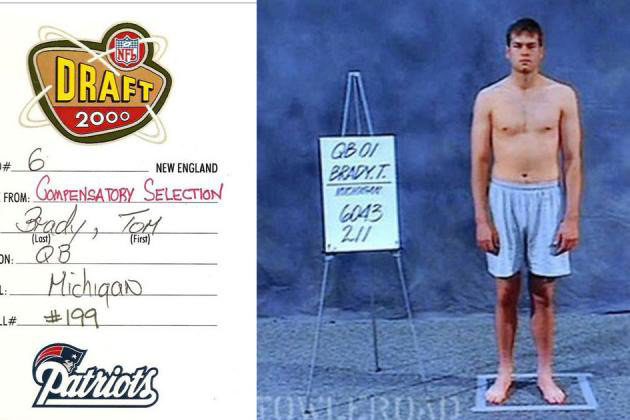
Perhaps no sports story better illustrates both the role of failure and the danger of hindsight bias than Tom Brady's journey to becoming the NFL's GOAT.
It's the 2000 NFL Draft. Brady, a quarterback from the University of Michigan, sits anxiously with his family as 198 players are selected before him. Six entire rounds go by. Six other quarterbacks are chosen ahead of him. When the New England Patriots finally take Brady with the 199th pick in the sixth round, it's almost an afterthought—they already had a franchise quarterback in Drew Bledsoe and two backups on the roster.
The scouting report on Brady was decidedly... uninspiring: "Poor build," "Skinny," "Lacks great physical stature and strength," "Lacks mobility and ability to avoid the rush," "Lacks a really strong arm," "Can't drive the ball downfield," "System-type player who can get exposed if forced to ad lib,"
Yikes. That doesn't exactly scream "future seven-time Super Bowl champion," does it?
Brady's NFL Combine performance was equally unimpressive. His 40-yard dash time was a glacial 5.28 seconds—one of the slowest times ever recorded for a quarterback. His vertical jump was just 24.5 inches, resembling less an elite athlete and more your dad trying to grab something off a high shelf.
Even the Patriots, who eventually drafted him, passed on Brady multiple times. Former Patriots executive Scott Pioli revealed that in the draft room, they kept looking at Brady on their board round after round, but continued to select other players. Only by the sixth round, when Brady was "all the way over to the left by himself" on their draft board, did they finally pull the trigger.
This is crucial: no one, including the Patriots, fully foresaw Brady's greatness. Even after drafting him, they kept him as a fourth-string quarterback his rookie year. Let that sink in—they had to use a precious roster spot just to retain their 6th round pick because they weren't confident enough to carry fewer QBs.
Now, here is where hindsight bias comes in. After 7 Super Bowl rings, 3 MVP awards, and virtually every passing record, it's tempting to rewrite history: "The Patriots were so smart! They saw something no one else did!" But as Coach Bill Belichick himself admits, if they had known Brady would become "TOM BRADY," they wouldn't have waited until the 199th pick to draft him.
The uncomfortable truth about success stories is that they often involve a healthy dose of luck, timing, and circumstances beyond anyone's control. After all, Brady only got his chance as a starter because Drew Bledsoe suffered a life-threatening injury in the second game of the 2001 season.
What makes this story even more instructive for strategic management is what the Patriots did to remind themselves of their own fallibility. Despite their growing dynasty with Brady, Patriots GM Scott Pioli kept a framed photo on his desk of Dave Stachelski—a tight end they drafted in the fifth round of that same draft, ahead of Brady. Stachelski never played a single game for the Patriots. The photo was Pioli's reminder that even successful organizations make mistakes and miss opportunities.
As Pioli put it, that photo said: "We're not infallible—we almost missed Tom Brady, and we did waste a pick on someone who never contributed." It's a brilliant bit of self-awareness: even in success (finding Brady), there was failure (misjudging both Brady's potential and wasting earlier picks).
The strategic lesson? Success often involves elements of failure and luck that get airbrushed out of the story after the fact. When someone succeeds wildly, we tend to rewrite history and say "We knew it all along," falling victim to hindsight bias. But the Patriots, to their credit, maintained a culture that valued reality over ego.
As Antoine de Saint-Exupéry wrote in The Little Prince: "Vain men never hear anything but praise." The Patriots refused to be vain; they forced themselves to hear criticism and remember mistakes even when everyone else was praising them.
This approach guards against complacency and hindsight bias—and it's something any organization can emulate. No matter how well you are doing, keep a "Stachelski" around (a lesson learned, a failed project, a critical voice) to remind you that you are not omniscient. Success can breed arrogance if you let it, but a bit of self-imposed humility keeps you learning.
Because here is the ultimate truth about the Brady story: Sometimes your organization's greatest success might be sitting right under your nose, almost missed entirely, and only recognized in retrospect. And your greatest failure might be the opportunities you never even noticed.
THE PHILOSOPHY OF FAILURE: WISDOM FROM RELIGION AND PHILOSOPHY
Far from being a modern Silicon Valley innovation, the transformative power of failure and suffering has been recognized in religious and philosophical traditions for millennia. Let's explore some ancient wisdom on why failing might not be such a bad thing after all.
In Christianity, the Apostle Paul wrote to the Romans:
"We also glory in our sufferings, because we know that suffering produces perseverance; perseverance, character; and character, hope."
This 2,000-year-old insight basically outlines failure as a forge for virtue. The sequence is remarkably precise: Hardship → endurance → character → hope. In Christian theology, failure isn't something to avoid at all costs; it's often the crucible that transforms us into better versions of ourselves.
Similarly, the Book of James encourages believers to "consider it pure joy... whenever you face trials of many kinds," since trials test faith and develop perseverance. The idea is that without troubles, we'd remain spiritually immature. As a strategic analogy, think of failure as weight-training for the soul—it breaks you down a bit, but in the process rebuilds you stronger.
Buddhism takes a complementary approach. The First Noble Truth asserts that suffering (dukkha) is an inevitable part of existence. The Dalai Lama has said:
"Remember that sometimes not getting what you want is a wonderful stroke of luck."
This is a profound reframing: a failure (not getting what you want) might actually be the universe steering you toward something better.
We have all experienced this. Remember that job you desperately wanted but didn't get? Or that relationship that painfully ended? Often, months or years later, we look back and think, "Thank goodness that didn't work out!" because it led to a better opportunity. The Buddhist perspective encourages us to approach failure with curiosity rather than despair, seeing it as part of a larger pattern we may not yet comprehend.
Friedrich Nietzsche gave us the famous maxim: "That which does not kill us makes us stronger." (Yes, Kelly Clarkson turned it into a pop song, but Nietzsche said it first!) His point was that struggle is what creates strength. Facing and overcoming challenges increases our capacity—a concept modern psychologists call "post-traumatic growth."
Interestingly, science supports this. A 2019 study in Nature found that young scientists who narrowly missed out on a research grant early in their careers (a professional failure) ended up publishing more high-impact papers later than those who narrowly secured the grant. The early setback seemed to forge determination and innovation, empirically proving Nietzsche's adage.
“Science is 99 percent failure, and that’s an optimistic view” - Robert Lefkowitz, Nobel prize laureate (2012) for his groundbreaking studies of G protein-coupled receptors.
Stoic philosophers like Epictetus and Marcus Aurelius similarly advocated approaching setbacks as training for the soul. If you lose money, see it as an exercise in learning frugality; if you endure criticism, practice patience and humility. Marcus Aurelius wrote, "The impediment to action advances action. What stands in the way becomes the way." In other words, the obstacle itself becomes your path to growth.
Across these diverse traditions, a common theme emerges: failure is not a pointless misery, but a teacher. In Christianity, it builds hope; in Buddhism, it cultivates compassion and detachment; in existential philosophy, it forges inner strength; in Stoicism, it turns obstacles into opportunities.
Even our common idioms reflect this ancient wisdom: "trial by fire," "school of hard knocks," "blessing in disguise," "what doesn't break you makes you stronger." These aren't just clichés—they are distilled human experience across cultures and time.
As strategic leaders (or just as humans), we can take comfort in this collective wisdom. When failure happens—and it will—we can remind ourselves: this isn't the end of the story. It might hurt now, but it can mold us into wiser, stronger, more compassionate people. As Paul said, failure can ultimately lead to hope—and hope is a powerful thing in business and life.
The practical takeaway? Don't just celebrate failure for failure's sake, but recognize its transformative potential. When you fail, ask: "What strength is this building in me? What lesson couldn't I have learned otherwise? How might this redirect me toward something better?" This reflective approach turns the pain of failure into the fuel for growth—something every strategic thinker needs.
IS FAILURE NECESSARY FOR SUCCESS?
Given all we have explored so far, let's address the elephant in the room: Do you really need to fail in order to succeed?
The word "necessary" is strong. In theory, it should be possible to succeed without major failures, perhaps by learning vicariously from others' mistakes. And yes, a few lucky individuals seem to glide from triumph to triumph with minimal setbacks.
But these exceptions prove the rule. For the vast majority of us, failure isn't just an unfortunate detour on the road to success—it is the road itself.
Why? Because success can be a lousy teacher. As Bill Gates observed,
"Success is a lousy teacher. It seduces smart people into thinking they can't lose."
When things go well, we often falsely attribute it to our genius or brilliant planning rather than favorable conditions or luck. We start believing in our own invincibility, setting ourselves up for a spectacular face-plant later.
Failure, on the other hand, is brutally honest. It shows us exactly where our assumptions were wrong, where our skills are lacking, or where our strategy needs adjustment. It builds the mental "muscle memory" for handling adversity that success simply cannot provide.
Consider the contrasting fates of two tech giants:
Microsoft dominated the PC era but initially missed the internet revolution. Bill Gates famously wrote his "Internet Tidal Wave" memo in 1995 after realizing the company was falling behind. That painful wake-up call forced Microsoft to pivot dramatically. Today, they are one of the largest companies in the world.
Meanwhile, Yahoo was the early internet darling, riding high through the late '90s and early 2000s. But without serious failure to sharpen their strategy, they missed mobile, social media, and search innovation. The company that once could have bought Google for $1 million ended up being sold to Verizon for a fraction of its former value.
As one venture capitalist put it: "I'd rather invest in someone who's failed and learned than someone who's only succeeded, because the latter doesn't know what it feels like to have the floor drop out from under them—and that will happen eventually."
In many fields, failure isn't just beneficial—it's mathematically inevitable on the path to discovery:
In pharmaceutical development, only 1 in 5,000 compounds makes it from lab to market.
In venture capital, about 75% of startups fail to return investors' capital.
In baseball, a .300 batting average (failing 7 out of 10 times) makes you an All-Star.
The key distinction isn't between those who fail and those who succeed—it's between those who fail productively and those who fail destructively. Productive failure leads to learning, adaptation, and growth. Destructive failure leads to blame, excuses, and repetition of the same mistakes.
That's why we don't aim for failure per se; we aim for bold attempts knowing that failure will be a natural byproduct. The goal is to shorten the loop from failure to learning to improvement. If you are failing repeatedly without learning, that's just wheel-spinning. If you are failing so catastrophically that you can't recover, that's too much failure at once.
Perhaps the best answer comes from Sara Blakely, the billionaire founder of Spanx. Growing up, her father would ask at dinner, "What did you fail at today?" If she had nothing to report, he'd be disappointed, because it meant she hadn't tried anything new or challenging. He wasn't celebrating failure itself, but the courage to attempt something difficult where failure was a risk.
So no, failure isn't absolutely necessary for success in every case. But learning is necessary for success, and failure tends to be the most potent catalyst for deep learning. It forces reflection in a way success rarely does.
The strategic implication? Don't seek failure for its own sake, but embrace the risk of failure as the price of ambition. If you are only attempting things you are certain will succeed, you are likely aiming too low. As hockey great Wayne Gretzky said, "You miss 100% of the shots you don't take."
While a fortunate few might succeed without tasting defeat, for most of us, failure is the almost inevitable intermediate step on the journey to success. The key is to fail productively—reflect on it, extract the lesson, and move forward smarter. Failure is like fertilizer—it stinks at first, but it enriches the soil, making later success bloom more vibrantly.
HOW MUCH FAILURE IS ENOUGH?
If failure is so beneficial, does that mean more failure is always better? Should we just fail constantly at everything?
Not exactly. Failure follows what I call the Goldilocks principle—too little, and you are not learning or pushing limits; too much, and you might become demoralized or seriously harmed. The sweet spot is "enough failure to learn and improve, but not so much that you can't recover."
In practical terms, the question "How much failure is enough?" is about finding the right balance. In a startup, for example, you can't afford to fail at everything—you have to succeed at some key things to stay afloat (like, say, making payroll or not violating regulations). But you also can't play it so safe that you make no mistakes; then you likely stagnate.
The ideal is often phrased as "Fail fast, fail cheap, and move on." You want failures that are:
1. Survivable. They don't kill you or your business.
2. Educative. They teach you something you couldn't learn otherwise.
3. Affordable. The cost (in money, time, reputation) is reasonable given the potential lesson.
4. Deliberate. They are part of a conscious strategy, not just sloppiness.
If you are failing repeatedly without learning, that's the wrong kind of failure (that's just wheel-spinning). If you are failing so catastrophically that you can't get up, that's too much failure at once.
Different contexts have different failure tolerances. For instance:
High stakes, safety-critical environments (like aerospace or surgery) have very low failure tolerance. NASA tests components rigorously on the ground so there are zero failures in space. That's why they say, "Failure is not an option."
Creative fields (like advertising or R&D) have high failure tolerance. A creative advertising firm might expect 90% of brainstormed ideas to be junk, but the 10% that are brilliant make it worthwhile.
Software development can tolerate moderate failure. A buggy beta release that can be patched is usually acceptable, while a security breach affecting user data is not.
One useful concept here is the marginal utility of failure: the first few failures in a new domain teach you tons. The tenth similar failure might teach you nothing new. So there's diminishing returns. You want to fail sufficiently to glean the insights, but not keep failing in the same way beyond the point of useful information.
Here's a handy rule of thumb: if your failures are starting to repeat themselves, you are not learning enough from them.
Consider Edison again. His thousands of failed lightbulb experiments weren't the same experiment repeated blindly. Each failure provided data that informed the next attempt. As soon as he discovered that one material wouldn't work, he moved on to another. He wasn't stubbornly repeating the same mistake—he was systematically eliminating what didn't work.
Another useful guideline: the higher the stakes, the less "failure tolerance" you have. A moon mission can't have too many failures because lives are at stake. That's why NASA tests components rigorously (small failures on the ground) so that there are zero failures in space.
In contrast, a software app can afford to launch with some bugs (small failures that can be patched). So "how much failure is enough" depends on context.
In your own development as strategic leaders, you might apply this principle differently at different career stages: Early career - higher failure tolerance. Try different functions, industries, approaches. The cost of changing course is relatively low, and the learning is high. Mid-career -- moderate failure tolerance. Experiment within your area of expertise, but avoid catastrophic reputation damage or financial loss. Leadership position - lower personal failure tolerance, but create safe spaces for your team to experiment and fail productively.
The key is to be deliberate about your relationship with failure. Have a "failure budget"—an amount of time, money, and reputation you can afford to risk on experiments that might not work out. When I teach entrepreneurship, I often tell students: "Plan to be wrong." That doesn't mean plan to fail completely, but rather acknowledge that parts of your plan will be wrong, and build in the flexibility to pivot.
So how much failure is enough? The amount after which you are a wiser person or organization. When you start hearing the same lesson from failure repeatedly, you probably have "enough" of that kind of failure and should adjust course.
In engineering, they say, "Fail safe and fail gracefully." That implies knowing when to cut losses. You don't keep driving the car after the check engine light and horrible clanking noises—you stop, learn what's wrong, fix it, then continue.
In business, "enough failure" means you have gathered the insight you need to make a better decision going forward. Beyond that point, failure is just failure.
ARE ALL FAILURES CREATED EQUAL? (LEARNING FROM WHICH FAILURES)
Not all failures deserve a standing ovation and a participation trophy. Some failures should be celebrated, others tolerated, and still others avoided at all costs. Let's break it down.
Amy Edmondson (HBR) developed a helpful spectrum of failures from "blameworthy" to "praiseworthy." Analyzing a failure is a bit like a crime scene investigation—you need to determine the cause, context, and culpability to respond appropriately.
Let's look at three main categories of failure:
Preventable Failures (Bad)
These are failures caused by inattention, incompetence, or rule-breaking—like a surgeon leaving a sponge in a patient or an accountant making a basic math error. These failures:
- Arise in routine operations where processes are well-established
- Could have been avoided by following known procedures
- Don't generate useful new knowledge (we already know not to do this)
When a preventable failure occurs, the appropriate response is training, coaching, process improvement, or occasionally disciplinary action. These failures should decrease over time in a well-managed organization.
Example: A chef who burns a steak because they weren't paying attention isn't generating valuable knowledge—they are just not executing known standards.
Complex Failures (Unavoidable)
These failures occur in complex systems with many variables interacting in unpredictable ways. Think of aviation accidents, where multiple minor issues cascade into a major problem, or software bugs that appear only under very specific conditions. These failures:
- Arise from interactions of multiple factors, often without a clear "culprit"
- Couldn't be fully anticipated even with diligence
- Produce valuable knowledge about system weaknesses
The appropriate response is thoughtful analysis, systems improvement, and contingency planning—not blame.
Example: When Facebook (now Meta) experienced a six-hour global outage in 2021, it wasn't because someone pressed the wrong button, but because of a complex interaction of networking protocols, security systems, and cascading effects.
Intelligent Failures (Good)
These are the gold standard of failures—deliberate forays into new territory where the outcome is uncertain but the potential gain is substantial. They:
- Arise from thoughtful experimentation in novel domains
- Couldn't be avoided without abandoning innovation entirely
- Generate invaluable knowledge that moves the frontier forward
These failures should be celebrated, analyzed, and shared widely throughout the organization.
Example: When Pfizer's researchers were developing a drug for hypertension and angina, it failed its primary goals. But they noticed an interesting side effect, which led to the development of Viagra—a much more profitable product than the original concept.
The key distinction is intent and process. Did the failure result from sloppiness, or from reasonable risk-taking? Was it a result of ignoring established protocols, or attempting something genuinely new?
Toyota is famous for its Andon cord system—any worker on the assembly line can pull a cord to stop production if they spot a quality issue. Stopping the line is technically a "failure" to meet production targets, but Toyota considers these high-value failures because they surface problems early. Each stop is analyzed, and a solution is implemented so that particular error won't recur.
The strategic lesson? Organizations need a "just culture" that distinguishes between these types of failures. If employees fear punishment for even well-intentioned failures, they will hide mistakes and the company won't learn. Conversely, if truly reckless failures are tolerated equally, that's organizational malpractice.
As managers, when a failure happens, ask: Was this a good failure or a bad failure? A good failure (for learning) might meet these criteria:
- It was in pursuit of a reasonable goal
- It was conducted properly and safely
- It just didn't work out due to inherent uncertainty
A bad failure might be one that violates known best practices or ethical standards (e.g., a pilot skipping the pre-flight checklist).
Your response should differ accordingly. Good failures merit praise ("thank you for taking that risk; we learned X, Y, Z from it"), while bad failures require accountability ("how do we ensure this protocol is followed in the future?").
Harvard professor Maxwell Wessel puts it this way: "A failed experiment is simply data with a negative sign." In other words, experiments that fail are just part of the learning process. But execution failures—like failing to carry out known procedures—are more problematic.
So no, all failures are not created equal. The quality of failure matters more than the quantity. A strategic leader asks not just, "Did we fail or succeed?" but rather, "What kind of failure was that, and what do we do with it?" When an organization gets this right, employees innovate without fear, and when something goes wrong, they rally to understand it instead of pointing fingers.
REJECTION THERAPY – OVERCOMING THE FEAR OF "NO"
If failure is so valuable, why does it still feel so awful? One big reason: our fear of rejection and failure is hardwired into our brains. Evolutionary psychologists theorize that for our ancient ancestors, rejection from the tribe was essentially a death sentence. No wonder we are terrified of it.
But what if we could hack this fear? Enter Jia Jiang, an entrepreneur who embarked on one of the most fascinating self-designed psychological experiments I've ever encountered (watch the video above).
After a crushing rejection for startup funding left him devastated, Jia realized his fear of hearing "no" was holding him back professionally and personally. So he created "Rejection Therapy"—deliberately seeking out rejection on purpose for 100 consecutive days.
The rules were simple:
- Make one outrageous request each day that would likely result in rejection
- Document what happens
- Reflect on what you learn
What does this look like in practice? On Day 1, Jia walked up to a random stranger and bluntly asked to borrow $100. Predictably, the man said no (and asked if Jia was okay).
On Day 2, he went to a burger joint, ate his meal, and then asked for a "burger refill" as if his cheeseburger were a bottomless cup of coffee. The puzzled cashier declined (clearly, free burger refills aren't a thing).
On Day 3, Jia asked a Krispy Kreme employee to make him donuts shaped like the Olympic rings, with interlocking colors. To his shock, the worker didn't reject him—she actually did it, creating a masterpiece of fried dough that went viral on YouTube. Jia got a yes where he expected a no!
Through increasingly creative stunts—asking to plant a flower in a stranger's yard, requesting a "home security inspection" at a random house, trying to play soccer in someone's backyard—Jia collected plenty of rejections. But along the way, he discovered something transformative: rejection lost its sting. By the 100th "no," he could shrug it off.
Perhaps more valuable, he learned techniques to increase his chances of getting a "yes":
Ask "why?" After receiving a rejection, asking "Why not?" often opened a conversation that led to compromise or a conditional yes.
Offer a reason. People were more likely to agree to odd requests when given a simple reason.
Build a connection. Taking a moment for small talk before making a request dramatically improved his success rate.
Be specific. Vague requests triggered suspicion, while specific ones often sparked curiosity or empathy.
The concept of Rejection Therapy is powerful for anyone afraid of failing or being told no (which is most of us). Jia's experiment shows that you can build courage like a muscle. By overdosing on rejection, you realize it's not lethal—it's merely uncomfortable. And once that fear subsides, you are free to take the chances that might lead to big success.
Jia's playful twist was to make rejection fun—turning it into a challenge to be conquered rather than a trauma to be avoided. His approach also illustrates the concept of antifragility we discussed earlier. Through deliberate exposure to small rejections, he built resistance to larger ones.
Could everyone benefit from a little Rejection Therapy? Probably. It doesn't have to be as extreme as Jia's 100 days, but deliberately stepping outside your comfort zone to ask for things—knowing you might get rejected—can be liberating.
The deeper lesson of Rejection Therapy is that the fear of failure is often worse than failure itself. Once you strip away the fear, failure (in this case, rejection) becomes merely feedback or even entertainment. Jia found many people were actually kind when saying no, and sometimes they'd engage in conversation, providing insight.
So, can people overcome fear of failure and rejection? Absolutely—by facing it head-on in incremental doses. If we even take a mini-version of Jia's approach in our lives, we'll likely find our comfort zone expanding, and with it, our opportunities.
So, perhaps you should try it (after all, you can get extra credit in my class for doing this).
CONCLUSION: FAILING FORWARD TO SUCCESS
After this lively tour of failure's virtues, one thing should be clear: failure is not the opposite of success—it's an integral part of it. In strategic management and in life, those who achieve great things are usually those who have dared to fail greatly.
The implication is not that we recklessly court disaster, but that we should not shy away from chances due to fear of failure. On the contrary, we should take calculated risks, knowing that even if we stumble, we can pick up invaluable lessons.
Should people take more chances? Yes, if those chances align with their goals and values. As we discussed earlier, Wayne Gretzky's cliché is still true: "You miss 100% of the shots you don't take." A startup that never launches will never get customers. A student who never raises their hand will never learn their true potential. A manager who never tries a bold strategy will never innovate beyond the status quo.
We've seen that failure—in safe amounts—can strengthen, educate, and inspire. So it stands to reason that we should allow ourselves, our teams, and yes, even our children to venture beyond the sure-thing comfort zone. We won't succeed every time; in fact, if we do, we are probably not aiming high enough.
Should families and educators allow more room for defeats? Absolutely. A child who is allowed to lose (at sports, competitions, even arguments) is a child who is learning resilience and adaptability. Overprotective parenting or "helicoptering" can unintentionally send the message that failure is too terrible to contemplate—and that paradoxically creates more fragile adults.
Instead, normalizing failure as part of growth would prepare young people to handle the adult world, where no parent or teacher can shield them from every mishap. Jonathan Haidt's work strongly suggests that by "mollycoddling" kids, we rob them of antifragility and fuel anxiety. Families that let kids experience setbacks (with love and guidance) are essentially teaching them: You can fail and you will be okay. You will come back stronger.
In education, encouraging intellectual risk (like attempting difficult problems, even if it means initial failure) leads to deeper learning than spoon-feeding the answers. We need to praise effort and learning, not just outcomes, so that a student isn't afraid to challenge themselves for fear of a B grade.
As a society, if we allow more little failures in a constructive way, we likely avoid the big meltdowns—be it personal breakdowns or massive business collapses.
From a strategic management perspective, the key takeaway is to build a culture that harnesses failure. This means creating systems where mistakes can surface quickly (and without fear), dissecting them for lessons, and sharing those lessons broadly. It means rewarding smart risks even if they don't work out, and responding to failures not with blame, but with curiosity and support (remember Ted Lasso?).
Companies like Google famously have "postmortems" for failures with the goal of learning, not shaming. Amazon celebrates projects like the Fire Phone as learning experiences that fed into later successes (like Alexa). Bill Belichick keeps that photo of a failed draft pick visible to remind everyone that there's always room to improve, even when you are on top.
When failure is treated as feedback, employees and teams become more courageous and innovative. They know a failed experiment won't end their career; instead it might be their ticket to spearheading the next improvement.
The profound message is that defeats are not something to be ashamed of; they are proof that we tried. As the inventor Sir James Dyson (who went through 5,126 failed prototypes before his successful vacuum) said, "There's no such thing as a mistake, just lessons learned."
If we can internalize that mindset, there's virtually no limit to what we can achieve, because we won't be paralyzed by fear of hitting the wall. We will know that if we hit it, we can climb it, or tunnel under it, or perhaps find a door we didn't see before.
In the end, strategic success—whether in business, academics, or relationships—belongs to those who are antifragile, who get better under pressure, who see failures not as scars but as badges of experience.
As American self-help author Napoleon Hill put it: "Most great people have attained their greatest success just one step beyond their greatest failure."
Or, put differently: Fail often, fail fast, learn from your mistakes. The more times you fail, the closer you are getting to success.
REQUIRED READINGS
- Haidt, J. (2006) "Flourishing" Ch.7 [download here]
- Anti-fragility: How to use suffering to get stronger [watch here]
- Edmondson, A. (2011). “Strategies for Learning from Failure.” Harvard Business Review [read here] [alternative link]
- Embracing Failure [watch here] Sara Blakely, CEO of Spanx, describes how her mindset of embracing failure has helped her take risks and learns valuable lessons.
OPTIONAL MATERIALS
- What it’s like to pursue a dream for 30 years — and fail [read here]
-- The best gift I ever survived [watch here]
-- The Biggest Reason Businesses Fail [watch here] John Taffer explains why the biggest reason businesses fail is blaming someone else.
- 100 Days of Rejection Therapy Can Make You Fearless [read here]
- The Reality of Failure [watch here] Entrepreneur Andrew Dreskin of Ticketfly discusses that accepting failure is critical
- Developing Grit [watch here] This video gives practical suggestions for developing grit.
- Conan O'Brien [watch here]
- Nietzsche on hardship [watch here]
- Steve Jobs: How to live before you die [watch here]
- The Last Lecture [watch here]
- According to New Research, You Should Probably Start Your Own Business [read here]
- Working with failure [read here] This article compares failure in different industries and gives practical suggestions for working with failure to learn from mistakes and decide how to move forward.
- 10 Amazing Entrepreneurs Who Had Accomplished Nothing By Age 30 [read here]