QUOTE OF THE DAY
"Strategy without tactics is the slowest route to victory. Tactics without strategy is the noise before defeat." - Sun Tzu, The Art of War
"In the business world, the rearview mirror is always clearer than the windshield." - Warren Buffett
"If you don't know where you're going, any road will get you there." - Lewis Carroll
"The best defense is a good offense." - Your uncle during Sunday night football
STRATEGY: A NOT SO SERIOUS GUIDE FOR *TOTALLY* SERIOUS DECISIONS
Welcome to our first lesson!
You might be thinking: "Strategy?" Isn't this just for CEO's, world leaders, and football coaches?
Of course not! Remember that time you told your parents you were "studying at the library" when really you were ... well, let's just say your GPA wasn't a top priority at that moment 🤪.
Or when you strategically picked that seat at the very back of the classroom ... because, you know, you have to check on your crypto portfolio every 5 seconds.
Not to mention the absolute bloodbath that is registration for classes every semester ... seriously, that ought to qualify you for a CEO role right away (updates resume ... "successfully registered for classes on my own for 8, ah, 6, i mean 3 semesters!").
Well, that's strategy in action! And you are already a strategic thinker! Congrats.
STRATEGY UNDER UNCERTAINTY: PASCAL'S WAGER
Let's start with the most obvious observation: strategy exists because we live in a world of uncertainty.
If we knew exactly what was going to happen tomorrow, well, there'd be no need for strategy. But we don't, and that's what makes strategy both challenging and exciting.
Speaking of life's big uncertainties, let's talk about Blaise Pascal, a 17th-century French philosopher, mathematician, and all-around smart guy (I mean he invented the syringe and the first public transit system).
He came up with what might be history's most fascinating "hedge bet" – Pascal's Wager.
Now, Pascal wasn't placing bets on horses or trying to predict the next hot stock (although he very much enjoyed gambling in his early life before he had a religious revelation that transformed him into a religious zealot). He was pondering the ultimate uncertainty: the existence of God.
Pascal concluded that believing in God was the optimal strategy, even if you don't know whether God is real.
His logic?
Well, if God exists, and you believe, you are looking at an infinite reward (eternal paradise). If God exists and you don't believe, well, you know the outcome in that case.
If God doesn't exist? It doesn't really matter what you believed. So, in Pascal's view, it's a no-brainer – if you don't know whether God exists or not, believing in God is the better strategic choice.
It's like buying insurance for your afterlife, a cosmic risk management strategy.
What do you think? Is this a good strategy?
STRATEGY MEETS BANANAS
Now, you might not be wagering on the existence of God every day (or maybe you are, no judgment here), but you are constantly making decisions under uncertainty.
Think about trading stocks. Are you going to sell those GameStop shares now, or hold them "to the moon" , hoping to hit that meme-stock jackpot?
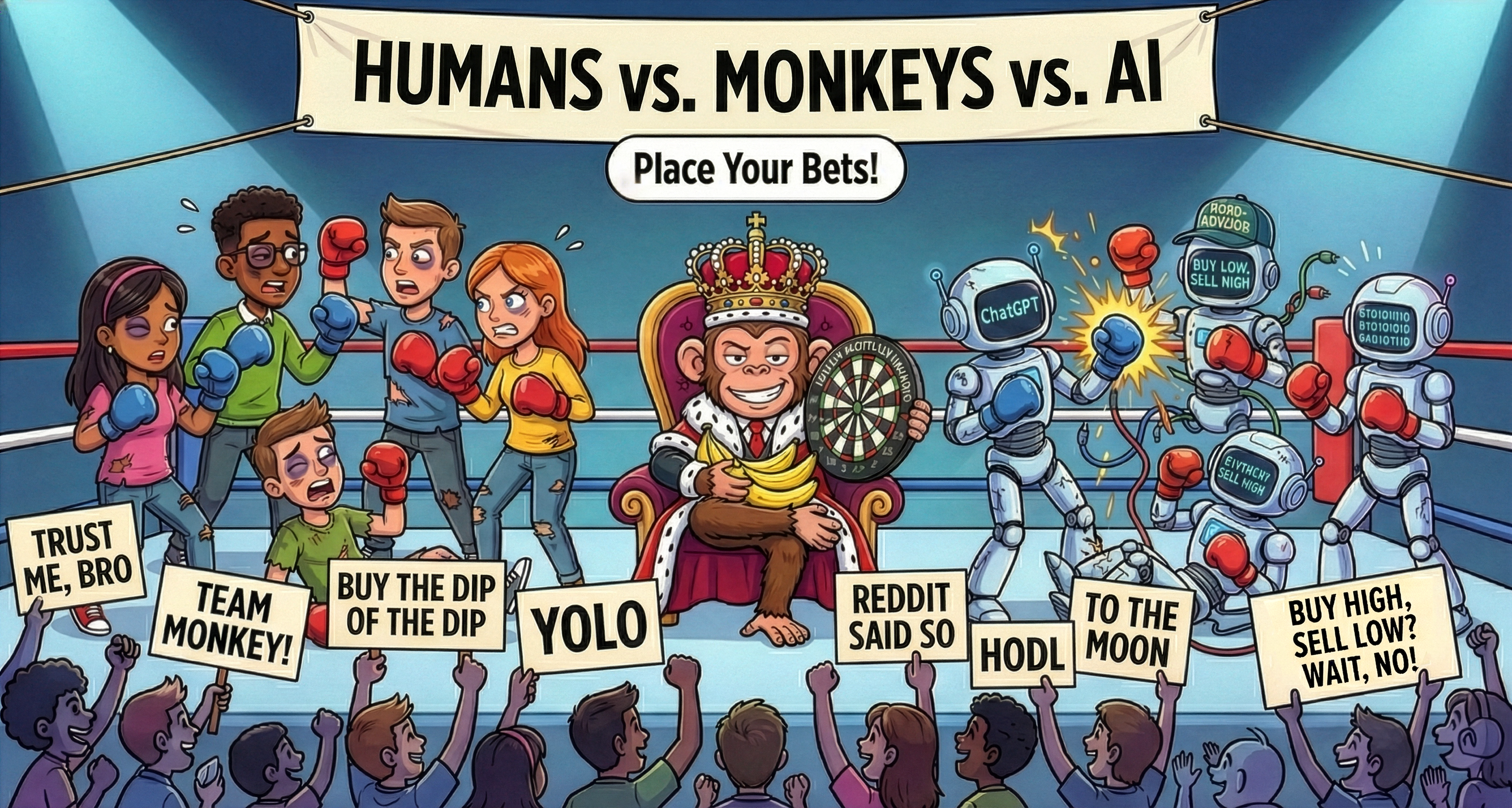
Speaking of stocks, did you know that Raven, a six-year-old chimpanzee, became the 22nd most successful money manager in the USA after choosing her stocks by throwing darts at a list of 133 internet companies. The chimp created her own index, dubbed MonkeyDex, and in 1999 delivered a 213 per cent gain, outperforming more than 6,000 professional brokers on Wall Street. [Guinness world records]
Another monkey, a Russian circus monkey named Lusha, created a portfolio that outperformed 94% of the country's investment funds. Or that a cat named Orlando outperformed a group of financial experts by picking stocks with his toy mouse?
These may sound like outlandish stories, but in 1973 the Princeton professor Burton Malkiel argued that a blindfolded monkey throwing darts at a list of stocks can do as well or even better than most financial experts.
This caused quite a bit of controversy, suggesting that those high-paid fund managers might not be as skilled as they seemed or that they should be paid bananas instead of millions in bonuses.
Rob Arnott of Research Affiliates tested this idea, creating 100 random "monkey portfolios" each year from 1964 to 2010. The result? 98 out of 100 of these random portfolios beat the market average! As Arnott put it:
"Malkiel was wrong, the monkeys have done a much better job than both the experts and the stock market."
These stories have some fascinating lessons for our strategic management course.
First, they suggests that our ability to predict the future, especially in complex environments like the stock market, is far more limited than we would like to believe.
I mean, think about your own future. If ChatGPT can write better than you, can see and control your computer, has access to all the information on the internet, and soon be more intelligent than all humans combined together, how do you prepare for such future?
Second, we want to feel a sense of control, and strategizing gives us that feeling, even if our strategies are based on flawed assumptions.
Third, the reality is that making sound decisions under uncertainty is incredibly difficult, and we may often be victims of survivorship bias, focusing on the few winners and attributing their success to skill rather than luck.
Finally, while we will learn about different strategies throughout the course, these findings should encourage a sense of humility.
This doesn't mean strategy is completely useless and that you should fire your financial advisor. Monkeys don't know how to open retirement accounts or plan for taxes, and they definitely won't help you negotiate your salary.
What this means is that we need to approach the course with a healthy dose of skepticism, a willingness to challenge our assumptions, and an awareness of the ever-present role of chance.
And maybe, we can learn a thing or two from those stock-picking monkeys.
Let's Play a Game
Ok, let's take a break and play a game.
Pick a number between 0 and 100. The winner will be the person whose number is the closest to 2/3 of the class average!
Take a moment to make a choice (think strategically of course) and write the number down on a piece of paper.
Ok. Now let's think through your choice strategically.
First, if you believe that other students in the class are super smart, you know that they will pick a number below 66.7 (2/3 of 100 = 66.7, which is the maximum possible number if everyone else picks 100). But if everyone realizes this, the new maximum target is 44.7 (2/3 of 67). And this process continuous until you eventually reach a 0.
However, if you believe that students are not rational and will randomly pick a number, the average will be around 50, so you should pick 33 (2/3 of 50). Pretty smart!
But wait ... what if everyone else thinks like this and picks 33, then you should pick 22! But then, if everyone figures this out and picks 22, you should pick 15 (2/3 of 22).
See where this is going?
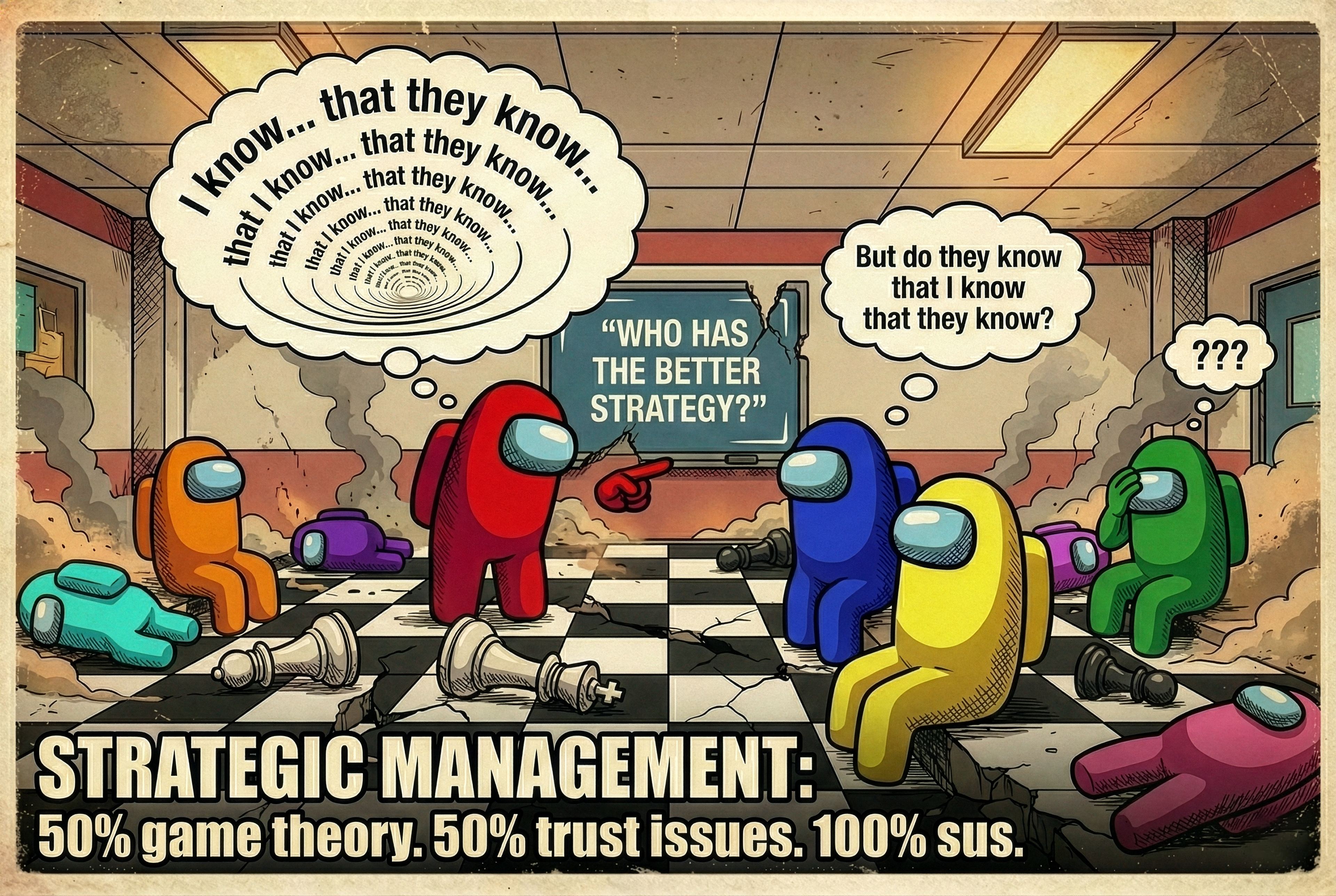
Strategy is the process of thinking about what others are thinking about what you are thinking about what they are thinking (phew!), ...
So, let me guess, did you pick a number between 30-35?
The Beauty Contest
John Maynard Keynes famously compared the stock market to a beauty contest (which is also the name of the game we just played).
He observed that successful investing isn't about picking the companies you think are best, but rather picking the companies other investors think are best.
Remember the GameStop saga? It wasn't about the fundamental value of the company--it was about investors trying to guess what other investors would do. Some made fortunes not because they believed in GameStop's business model, but because they correctly anticipated how other traders would behave.
This game teaches us something profound about strategy: Sometimes, the optimal choice isn't about what you think is right, but about what you think others will think is right.
The same principle applies to creating value in business. As Y Combinator's motto goes: "Make something people want." It sounds obvious, yet countless startups fail because founders fall in love with their solution before understanding if anyone actually wants it (google glass, the metaverse, and countless other failed products).
The magic of strategy lies not just in creating something great, but in creating something that others truly value. And that requires understanding both your own capabilities AND what others will think is valuable – which brings us back to Keynes' beauty contest.
Want to know why I guessed you picked a number between 30-35? In experimental settings, the average tends to be around 30-35, suggesting that most people think through one or two levels of strategic reasoning but don't go all the way to zero (which is the solution of the game when played by rational actors).
Strategic Dilemmas
The point of the Beauty game is that your strategies don't exist in isolation. Rather, many outcomes in life (and business) depend not only on what you do, but also on the choices of others.
After all, whether you get that internship (or job) depends on only on how good you are, but also on how good (or bad) everyone else is (your competition)!
Game theory is a powerful tool for understanding such strategic interactions. One of its most famous concepts is the classic Prisoner's Dilemma game. It's a scenario that shows how seemingly rational individual choices can lead to a collectively worse outcomes.
Imagine two suspects, arrested for a crime, are separately offered a deal. If one confesses (defects) and the other stays silent (cooperates), the defector goes free while the other gets a harsh sentence. If both stay silent, they both get a light sentence. But if both confess, they both receive a moderate sentence.
The dilemma?
No matter what the other person does, each suspect is individually better off defecting. But if they both defect, they both end up worse off than if they had cooperated.
This seemingly simple game has profound implications, mirroring real-world situations ranging from nuclear arms races (as seen with the US and the Soviet Union during the Cold War) to impalas grooming each other to remove ticks (watch the video above). The game can also explain the raise of the state and why we are altruistic from an evolutionary perspective (check out Peter Singer's essay read here).
In essence, the Prisoner's Dilemma reveals a fundamental tension between individual rationality and collective well-being. Sometimes the rational strategy may not be the best one.
The Long Game
However, the Prisoner's Dilemma often represents a simplified, one-shot scenario. But in most real-world situations, interactions are not isolated events – they are repeated over time (what we call repeated games). This fundamentally changes how you approach strategy (and how the game is played).
Here is a fun fact: Studies show that prisoners – yes, actual inmates – are better at cooperating in repeated Prisoner's Dilemma games than students! Even members of organized crime, like the Camorra (Neapolitan 'Mafiosi'), demonstrate higher levels of cooperation than, you guessed it, business students.
Why might this be?
One explanation is that prisoners, and especially members of organized crime, often live in environments where reputation, trust, and the consequences of betrayal are significant. They have experience with repeated interactions, where a single act of defection can have long-lasting repercussions. They understand, perhaps intuitively, that cooperation, even if risky in the short term, can be beneficial in the long run. They've learned, in a sense, the lessons that emerged from Robert Axelrod's computer tournaments (watch the video above).
In the 1980s, Axelrod explored repeated Prisoner's Dilemma games and found that the most successful strategy was actually rather simple "Tit for Tat" – cooperate initially, then mirror your opponent's previous move. His research highlighted the importance of being "nice," "forgiving," "retaliatory," and "clear" in repeated interactions.
These findings resonate with the observed behavior of prisoners and even some criminal organizations, suggesting that they may have implicitly grasped these principles through their lived experiences. It seems that in the long game of repeated interactions, cooperation can emerge and even thrive, even among individuals who might be expected to act solely in their own self-interest.
This is true for countries too. Think of the US and Russia. Eventually, they realized that in the long run, it is better to cooperate. Both countries spent around $10 trillion developing nuclear weapons. Both would have been better off if they had cooperated and agreed not to develop this technology further. But since they both acted in their own best interest, they ended up in a situation where everyone was worse off.
You can play the Prisoner's Dilemma against a computer here [Claude artifact]
When Good Strategies Clash: The Social Dilemma
What happens when everyone's optimal strategy leads to an outcome nobody wants?
Game theorists call these situations "social dilemmas," and they are far more complex than they first appear.
Consider fishing in international waters. Each company's strategy is clear: maximize your catch for maximum profits.
But when everyone follows this rational strategy, fish populations collapse, destroying the very industry everyone was trying to profit from. Everyone is left worse off.
The fascinating part?
Some communities have solved this dilemma brilliantly. In Japan, local fishing communities have managed shared fishing grounds for centuries through a system called "fishing rights." By giving fishers a long-term stake in the resource and establishing clear rules for cooperation, they transformed a tragedy into a sustainable success story.
Or take rush hour traffic. Your individual strategy seems obvious: drive your car for convenience. When everyone makes this choice, we get gridlock. Yet some cities have cracked this puzzle. Singapore implemented a dynamic pricing system for road usage - when traffic is heavy, the cost of driving increases. By aligning individual incentives (avoiding high fees) with collective benefits (reduced congestion), they turned a social dilemma into a manageable system.
Climate change might be the ultimate social dilemma of our time. But even here, strategic solutions exist. When the ozone layer was depleting in the 1980s, countries faced a similar collective action problem. The solution? The Montreal Protocol -- a combination of binding targets, economic incentives, and technology transfer that successfully phased out ozone-depleting substances. It worked because it aligned individual country interests with collective benefits.
The key insight?
Social dilemmas can't be solved through individual strategy alone -- they require mechanisms that align individual incentives with collective outcomes. Sometimes it's property rights (like fishing communities), sometimes it's pricing (like Singapore's roads), and sometimes it's international cooperation (like the Montreal Protocol). The trick isn't just identifying the problem; it's designing systems and laws that make cooperation the strategically smart choice.
CLASSROOM EXERCISE
ARE YOU SMARTER THAN A STOCK-PICKING MONKEY?
Let's find out!
The Players
- Student Teams (grouped by major, 4-5 students per team)
- The Monkey Portfolio Manager (randomly picked stocks)
- Four AI Portfolio Managers (ChatGPT, Perplexity, DeepSeek and Gemini)
- Experts
The Challenge
Each team will create a $100,000 portfolio by selecting 5 stocks from our list of 20 tech companies (see below) and deciding how to allocate the funds. You can allocate the funds any way you want.
THE COMPANIES (TICKERS)
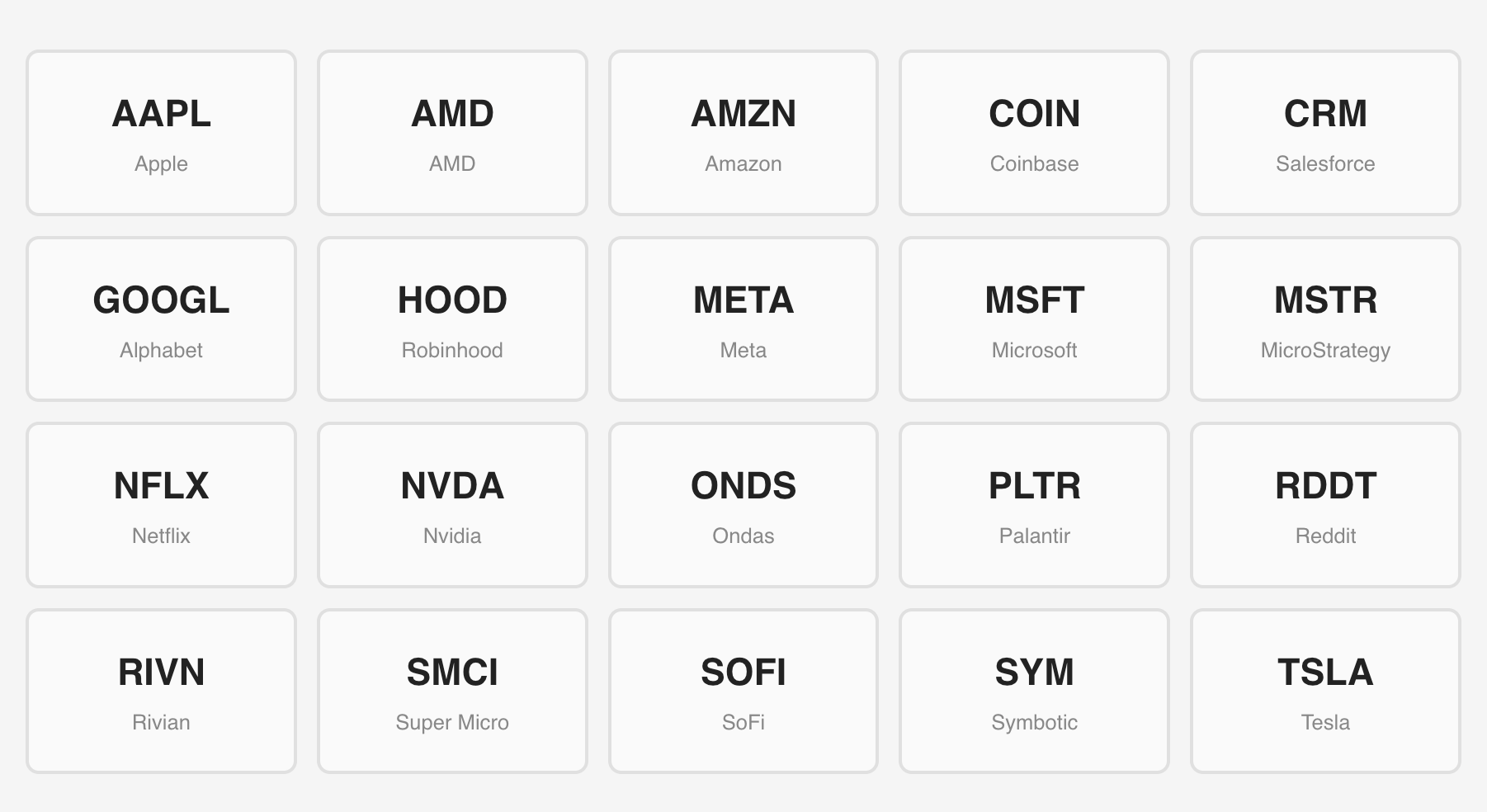
Your Task
Research: Divide the 20 companies among team members
Select: Choose 5 companies for your portfolio
Allocate: Decide how to split your $100,000 among the 5 companies.
Document: Write ONE sentence explaining your strategic rationale for each pick.
The Competition
You can create your portfolio on this webpage: https://studentsvsmonkeysvsai.replit.app/
We will track performance for one month (you can always check on your portfolio looking at the leaderboard on the webpage above).
May the best analysts (or primates, or robots) win!
Good luck! :)